Yangon, Formerly Rangoon

On Monday, March 21, we arrived in Myanmar around 10:30pm after a long yet smooth eleven hour travel day.  Although Bhutan is pretty much next door, there are only a few cities that Druk Air will fly in and out of so we had a four hour flight from Paro to Bangkok, a five hour layover and then a two hour flight to Yangon.  As we exited the plane, we immediately felt such a drastic change in weather.  It was roughly 55 degrees in Paro when we left and at least 95 degrees now – at night, after the sun as been fast asleep for hours.  With every step we took on the tarmac, we were shedding layers of clothing the way snakes shed skin.  Less is definitely more.  Once we went through immigration and got our passports stamped, we were greeted by two guys from our hotel, which I pre-arranged for at a hefty fee of $20 USD. Given how late it was, we felt it was definitely worth the convenience.  Plus, they were rolling deep in a black leather, tinted windows, fully air conditioned SUV.  The minute the blast of a cold breeze tickled my face, I instantly felt a relief from the tiny bubbles of sweat quickly developing on my upper lip.  If you’re sexy and you know it clap your hands.  So attractive, I know.

After a thirty minute drive, we pulled up to our hotel, Merchant Art Boutique, at 11:15pm.  Very modern, new and clean.  Our room was $70 a night.

DSC07112

DSC07116

In order to fully appreciate this country, we felt we needed to fully understand this country.  And since Myanmar was such a mystery to us, we decided to do some research on where it has been, where it currently stands and where it hopes to go.  It is not a place that is widely talked about (at least not in the conversations I have) nor is it a place that Westerners are relatively familiar with (correct me if I’m wrong, although that’s very rare, wink wink).  It is not as black and white as some of the other areas we’ve visited or will be visiting either.  And since I’m such a good friend, I’ll give you the very vague cliff notes version from what I learned so you too can be better educated.

Some people have heard of Myanmar while others haven’t.  Some people have heard of Burma while others haven’t.  Either way you spin it, Myanmar and Burma are actually the same thing.  It’s like all the other countries or cities out there that have changed names within the last century – Bombay to Mumbai, Persia to Iran, Peking to Beijing, Saigon to Ho Chi Minh City, Kampuchea to Cambodia, Siam to Thailand, Russia to Soviet Union then back to Russia (wonder why they were Russian for a change -HA).    Myanmar shares a border with five countries including India, Bangladesh, China, Laos and Thailand.  As wild as this sounds, there are more than 135 different ethnic groups, each with its own history, culture and language. Myanmar became an independent state in 1948, after gaining its sovereignty from The United Kingdom. Then the ruling military junta changed its name from Burma to Myanmar in 1989, a year after thousands were killed in the suppression of a popular uprising. At this same time, Rangoon, the largest and most commercially important city,  received a new name as well – Yangon.  These changes were recognized by the United Nations as well as France and Japan; however, many English speaking countries such as the United States, the United Kingdom, Australia and Canada still referred to it as Burma.  As both names are currently used by the locals, Burma is considered more popular while Myanmar is viewed more literary.  The decision to continue using Burma was rooted in a desire to show disapproval for the noxious regime.

A big reason why Myanmar is so mysterious to the outside world (in my humble opinion at least) is because its doors were closed to tourism for nearly 50 years due to the army-imposed isolation that turned the country somewhat upside down.  It wasn’t until 2010 that they started allowing foreigners to enter their home again.  Due to this closure, Myanmar is not like its neighboring countries.  It is quite untouched, undiscovered and unchartered territory compared to the rest of the region.  It isn’t part of the typical “backpackers” route of Southeast Asia but since Vinny and I dare to be different, we added this to our list anyways.  Plus, my friend Kari visited in 2013 and our family friends Mark and Dorith visited in 2014 – both coming back with rave reviews.  It is nearly impossible in this day and age to experience a country not heavily impacted by tourism so this was our one opportunity to see the real Myanmar.

Day 1 – March 22nd

Today is our 69th day on this wild and crazy adventure (yes, I’m counting).  Surprisingly, its has all gone ridiculously well.  Flights have been relatively on time, trains never broke down, hotels on average were all up to par and never once did we get sick (well I had a weird fever for two days while in Jaipur but that doesn’t really count).  I continued to rub my lucky crystals (thanks Carole!) because it is a miracle nothing happened while in India, Nepal or Bhutan given how underdeveloped those three countries are.  I kept pinching myself to make sure I wasn’t dreaming.  But unfortunately, that pinch soon became too real.  Vinny woke up this morning feeling a little nauseous.  We thought it was maybe because of the heat, maybe because we were drained from the past 2+ months of constantly being on the go or maybe because he was hungry.  We were leaning more towards the latter so we went downstairs to the complimentary breakfast and put some nutrients in our bodies.  But that only made things worse.  Around 1pm, he started throwing up.  And throwing up.  And throwing up.  Uh oh, could this be food poisoning?  I’ve never had it so I can’t diagnose him but he kept saying it was a different feeling than when he had it a few years back.  Either way, he was super sick which totally sucked.  Every time he would drink water, his body would reject it so he had no liquids and no food to give him any sort of strength.  As he continued to move from the bathroom to the bed and vice versa (sorry for the nasty visual), I twiddled my thumbs in a 25 square meter room with no one to talk to and nothing to do.  I was somewhat going crazy so I ended up taking a walk around our hotel neighborhood in hopes of finding saltine crackers and some sort of sports drink with electrolytes.  But we aren’t in the USA.  And we aren’t in Europe.  Nor are we in South America even.  Brands like Gatorade don’t really exist here.  Starbucks and McDonalds don’t even exist here.  Right when I was about to give up hope (mainly because I couldn’t really handle the massive drops of sweat creeping down my back anymore), I came across a tiny convenient store called Grab & Go.  And wallah, they had some kind of drink with electrolytes AND fairly plain crackers.  Just like that, I quickly became a hero.  Hopefully Vinny can keep them both down…

Day 2 – March 23rd

Even after a restful night sleep, Vinny woke up feeling weak, tired and nauseous still.  He stopped throwing up around 11pm and thankfully didn’t wake up in the middle of the night.  This made us question whether or not it was in fact food poisoning.  Let the unknown remain but let’s just hope he feels better tomorrow.  Although it completely sucks to be in his position right now, the timing couldn’t have been any more perfect (easy for me to say).  The reason for this is because we have absolutely nothing planned for the first time on this trip.  We paid for three nights at this hotel but we don’t know where we are going next, how we are getting there or how long we’ll be there.  Worse case, we extend our Yangon stay a few more nights to actually see the city, once the V is feeling like Superman again.

Day 3 – March 24th

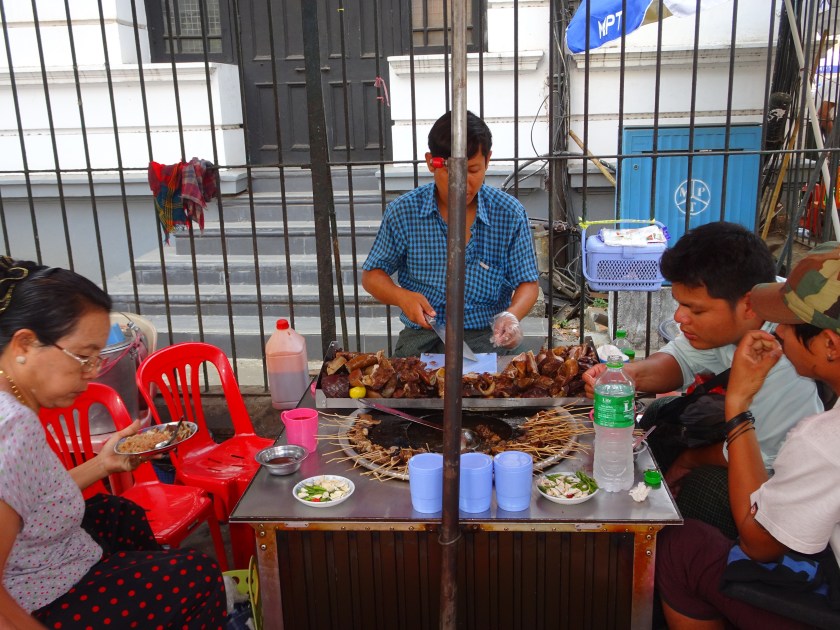
A new day, a new you!  After resting to regain his energy yesterday, Vinny is finally feeling somewhat like himself.  Hip hip hooray!  I’m first and foremost happy for him but selfishly, I’m yearning to get outside and explore.  Since it is about 105 degrees (yuck), we decided to take things a little slower than usual to make sure he doesn’t relapse.  We held hands over a casual stroll, passing by rainbow colored apartment buildings and an abundance of street stalls serving local food.  It seems to be normal for adults to sit on what looks like plastic chairs and tables made for children.  Not just at one or two or three different places but at every single location we passed by.  Very interesting.

DSC07113

DSC07117

DSC07118

DSC06933

We then stopped by a decently sized department store for some more toiletries and ended up getting two umbrellas as well.  You’re probably thinking “oh, is rain in the forecast?”.  Which is a totally legit question.  But no, it’s not.  We got them to cover ourselves from the sun because it’s ridiculously strong and somewhat miserable.  The UV Index is 11.  I’ve never seen it that high in my life.  Usually it’s below 7 but not today, not in Myanmar.  Plus, all the locals have an umbrella so why not try to fit in.  It’s a win-win.  In the famous words of Rihanna, “When the sun shines, we’ll shine together.  Told you I’d be here forever.  Said I’ll always be a friend.  Took an oath I’ma stick it out ’til the end.  You can stand under my umbrella.  Ella ella eh eh eh”.  If you imagine me singing that song, it sounds way better, I promise.

DSC06935

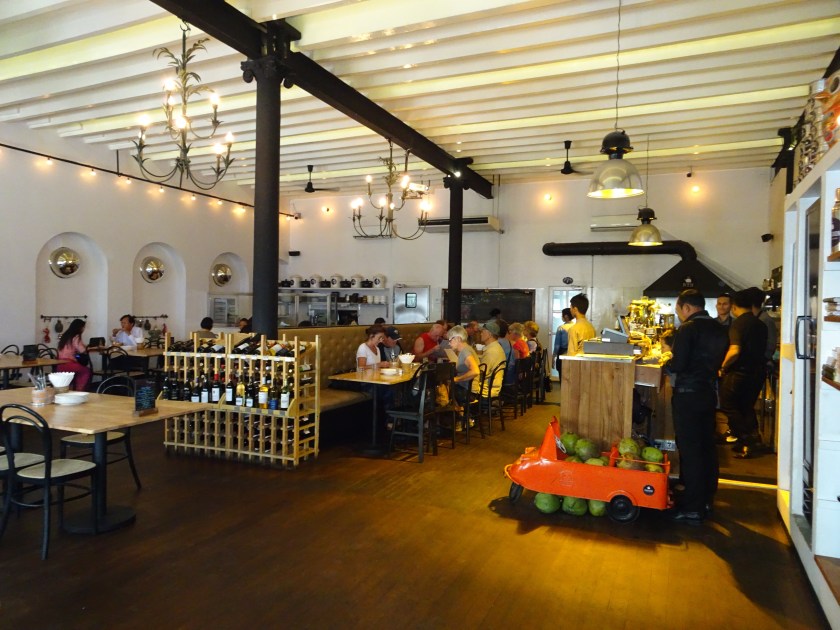
Now that we had permanent shade to protect our delicate skin (mine is an absolute mess at the current moment, P.S.), we walked to lunch at the Rangoon Tea House, a place recommended by our hotel, TripAdvisor and Lonely Planet.  It had a very westernized look and feel but the air conditioning was much appreciated.  And we needed food that was on the simpler, lighter side so Vinny could stomach it (literally).

DSC06931

DSC06930

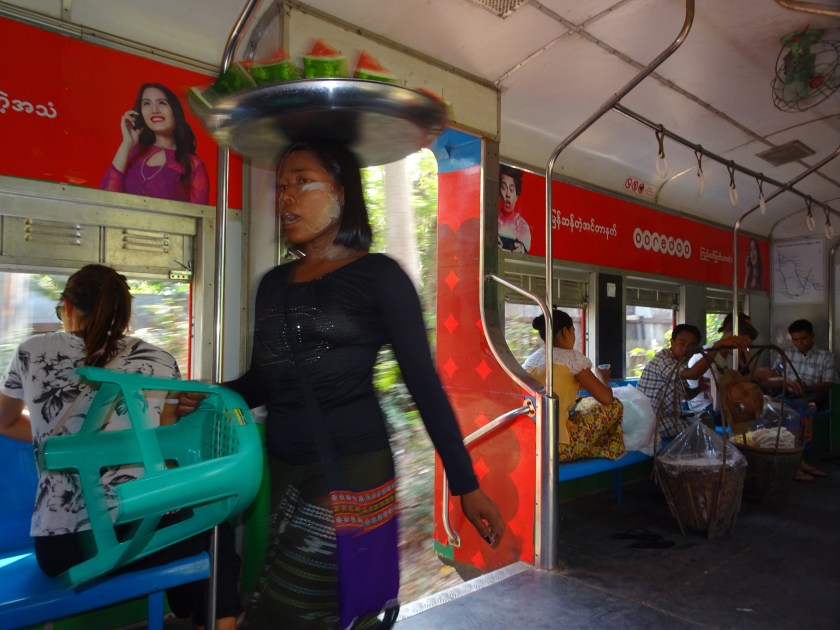
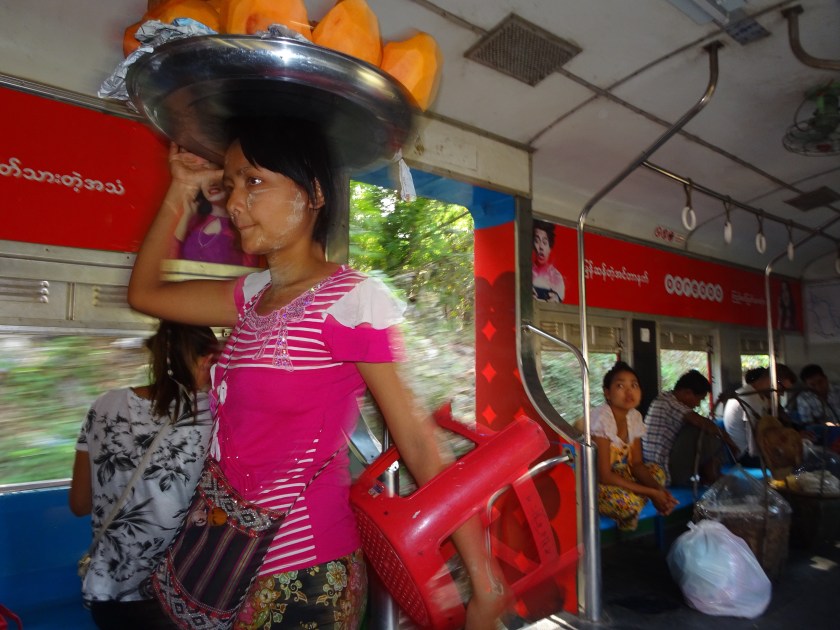
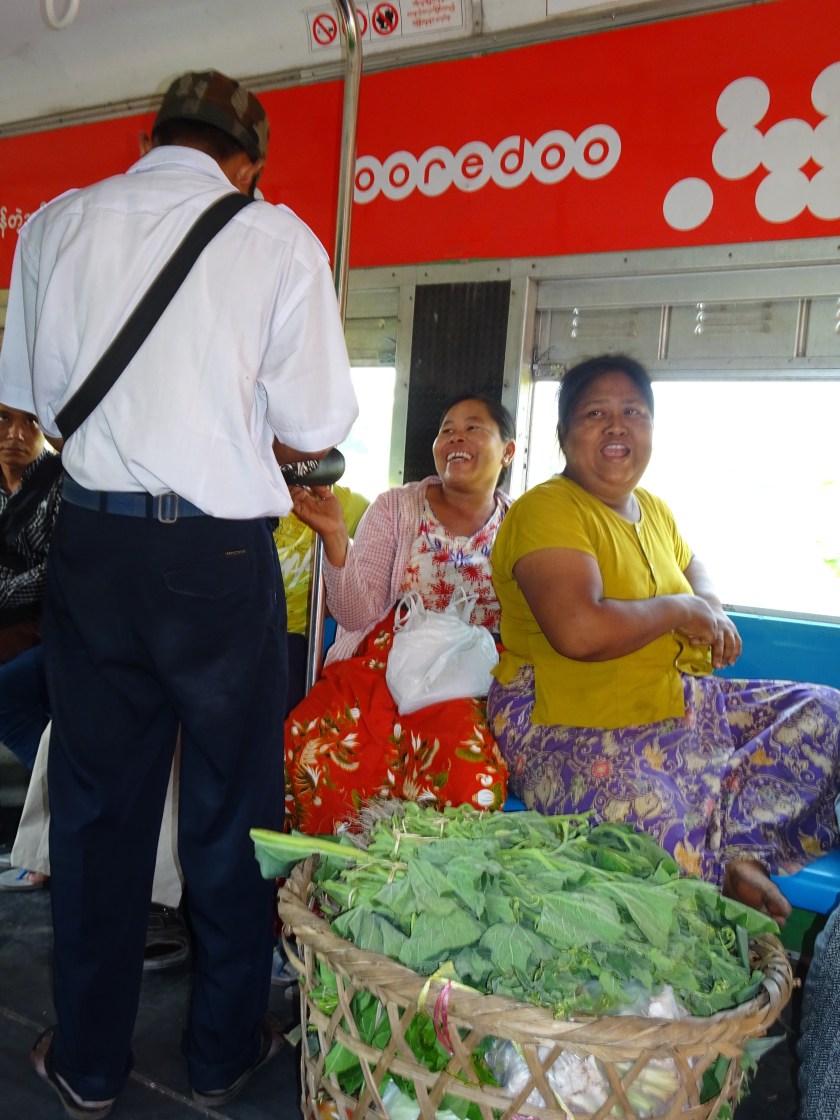
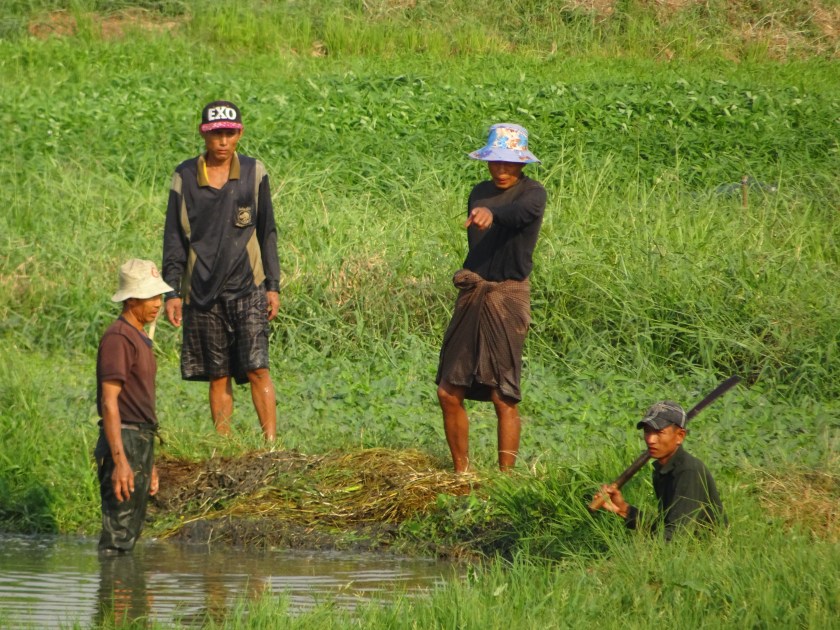
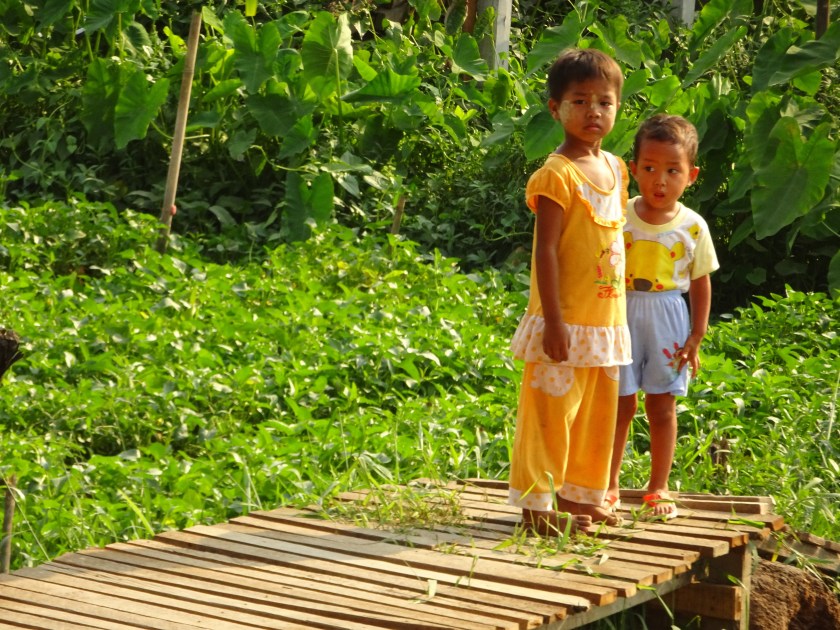
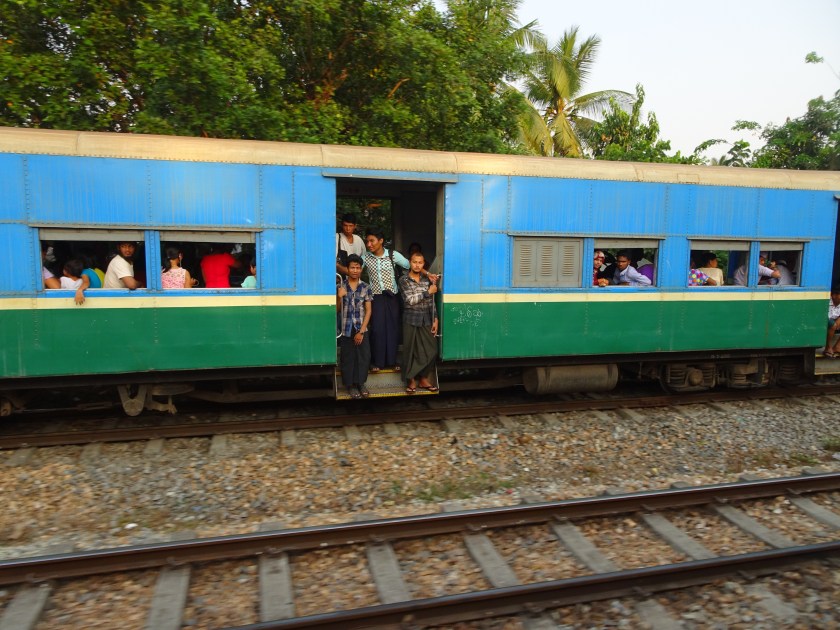
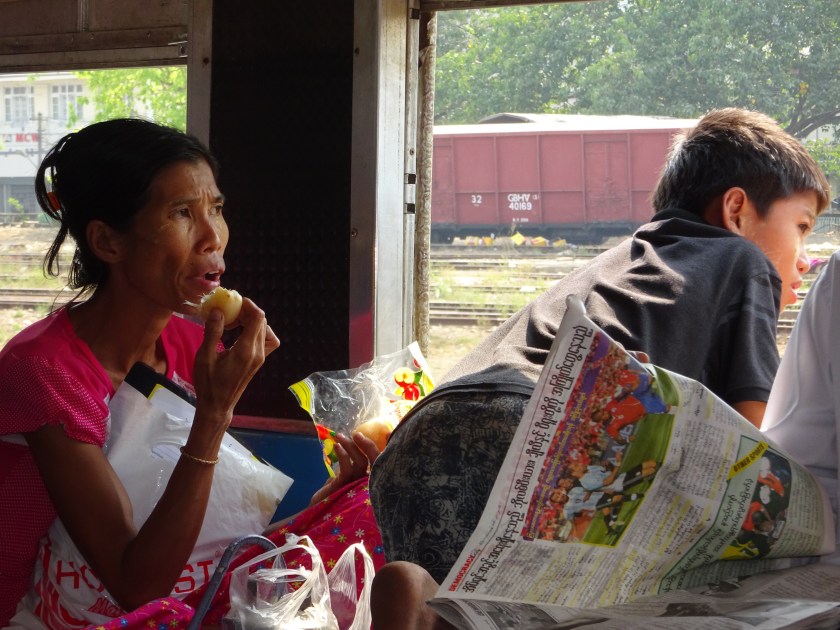
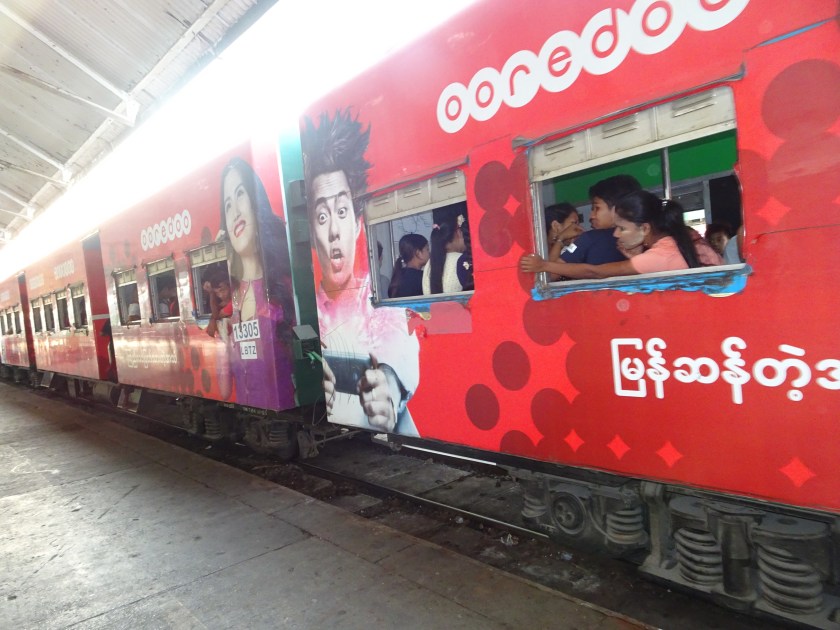
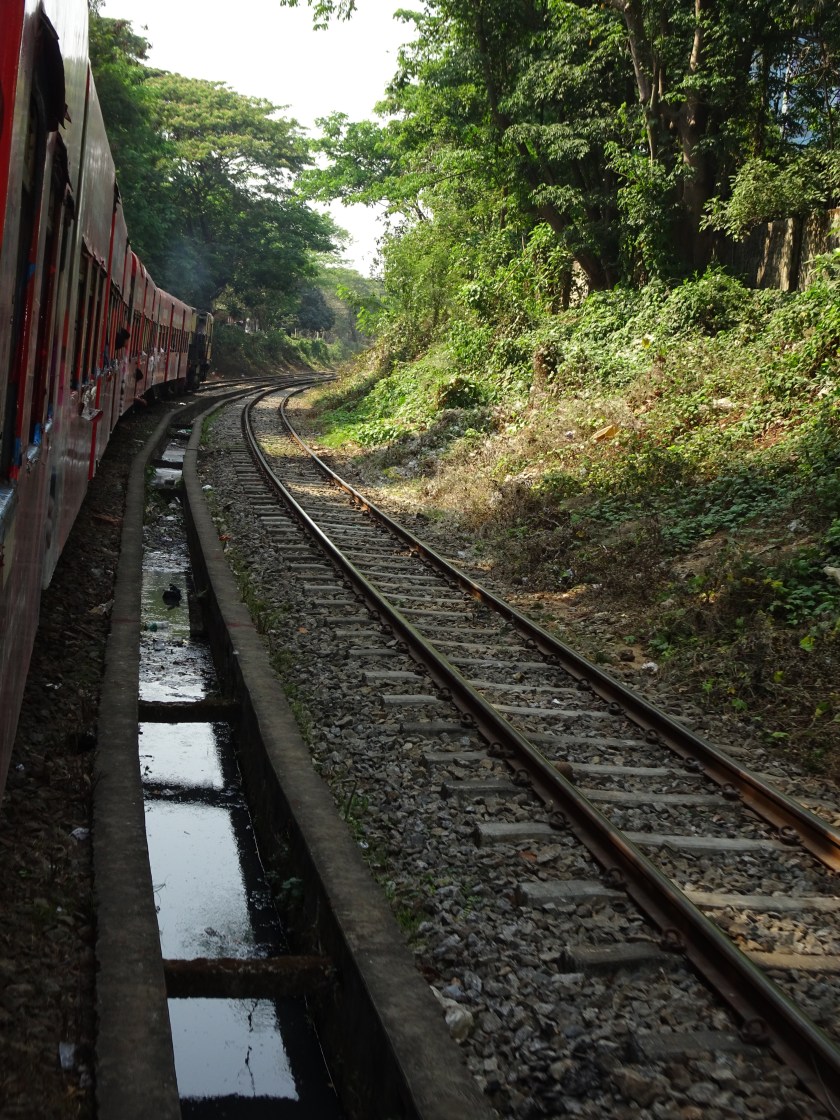
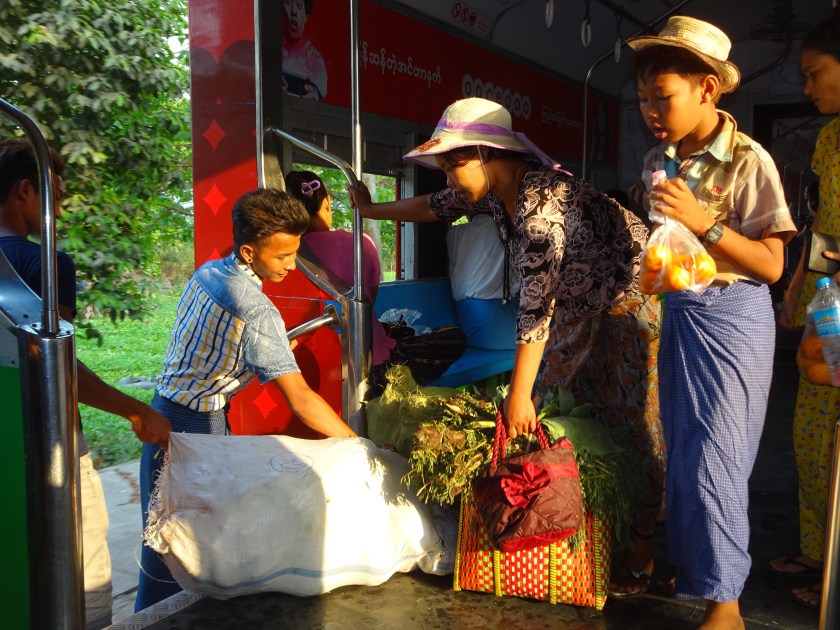
Next up, we went on The Circle Train.  This was a three hour journey allowing us to get a realistic glimpse into rural Yangon for a whopping 400 Kyat or $.33 (that is cents, not dollars).  Outside of the city, miles aways from the touristy areas, we witnessed locals living their normal everyday lives.  The Circle Train is a commuter transportation outlet that brings people to the city as well as out of the city.  Some are using it to get from home to work and vice versa while others actually work on the train, trying to make every last Kyat they possibly can – whether it’s selling various fruits, vegetables, water, rice crackers, hats, newspapers, etc.  You name it, it’s sold here.
DSC07024.jpg

DSC06949

DSC06970

DSC06952

DSC06955

DSC06963

DSC06984

The carriage rocks and rumbles as you slowly make your way through 45.9 kilometres of track via 39 stations which forms a loop around Yangon. Stopping at each and every station for only a minute or two, people clamber on with only seconds to spare, lugging more belongings than they can usually handle. The train returns back to Yangon’s city station before making the same journey over and over again throughout the day.  The more stations you pass, the more the landscape changes from city concrete to paddy fields and rustic villages, and the more passengers the train picks up.  This is, after all, one of the main and cheapest forms of transportation for the populace.
DSC06954

DSC06975

DSC06989

DSC06995

DSC07016

DSC07021

There was no air conditioning on the train but there was a slight breeze coming through the open windows, although the maximum speed is 17 mph so it’s fairly slow.  By the end of our journey, my legs produced enough sweat on the plastic seat to fill a kiddy pool.  And with every stroke of wind that made its way past my nose, I couldn’t help but smell so many different scents – food, trash, body odors, vegetation, etc.  Your senses are on overload, while your eyes just want to divert to the tranquil countryside.  Before you know it, the train pulls into its next stop, folks exit and a whole new set of characters enter for the next leg of the journey.
DSC07013.jpg

DSC06948

DSC06958

DSC06966

About halfway into the ride, an older local gentleman sat next to me.  He kept to himself at first but then he kindly asked where we were from.  When I said the USA, he quickly replied, in a high pitch voice and with a Broadway like expression, “YOLO!”.  It was impossible not to burst into laughter (in a respectful manner of course) simply because of the way he said it and because that’s what he thinks of when he hears America.  Wow, we have such a great reputation out there.  Since the Circle Train is his commute everyday, he has taken it upon himself to learn English now that tourism is booming.  He takes advantage of being on the train with foreigners and tries to learn new phrases all the time.  He actually keeps a little journal and has people from all over the world sign it. What an awesome concept.  When he asked me to sign it, I taught him FOMO.  For those of you who don’t know what either acronym stands for, let me know teach you too.  YOLO is “You Only Live Once”, meaning go skydiving or book that one way ticket or try frog legs or finally enroll in that photography class you’ve been wanting to take.  FOMO is “Fear Of Missing Out”, meaning you feel the need to be everywhere all the time because you are afraid something will happen if you’re not there.  Both are not educated sayings but they are frequently used by my generation.

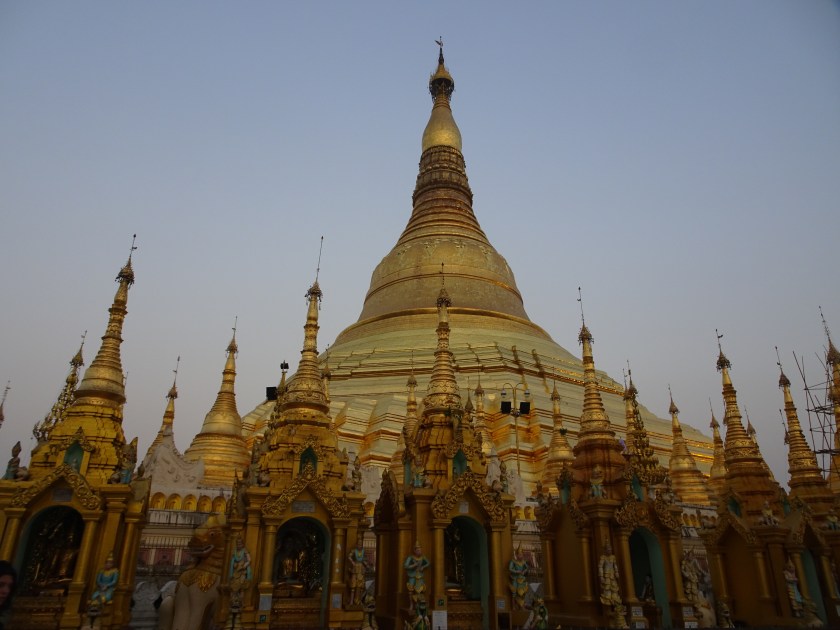
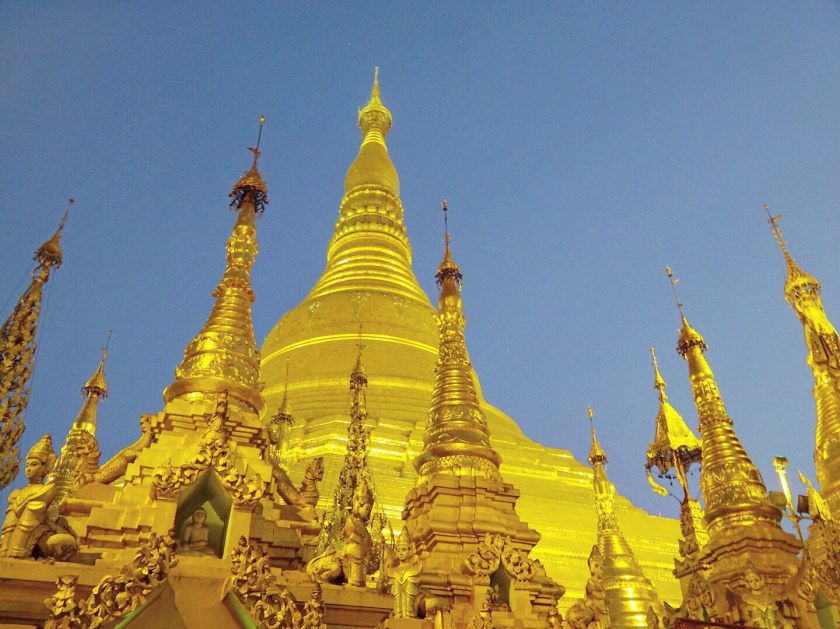
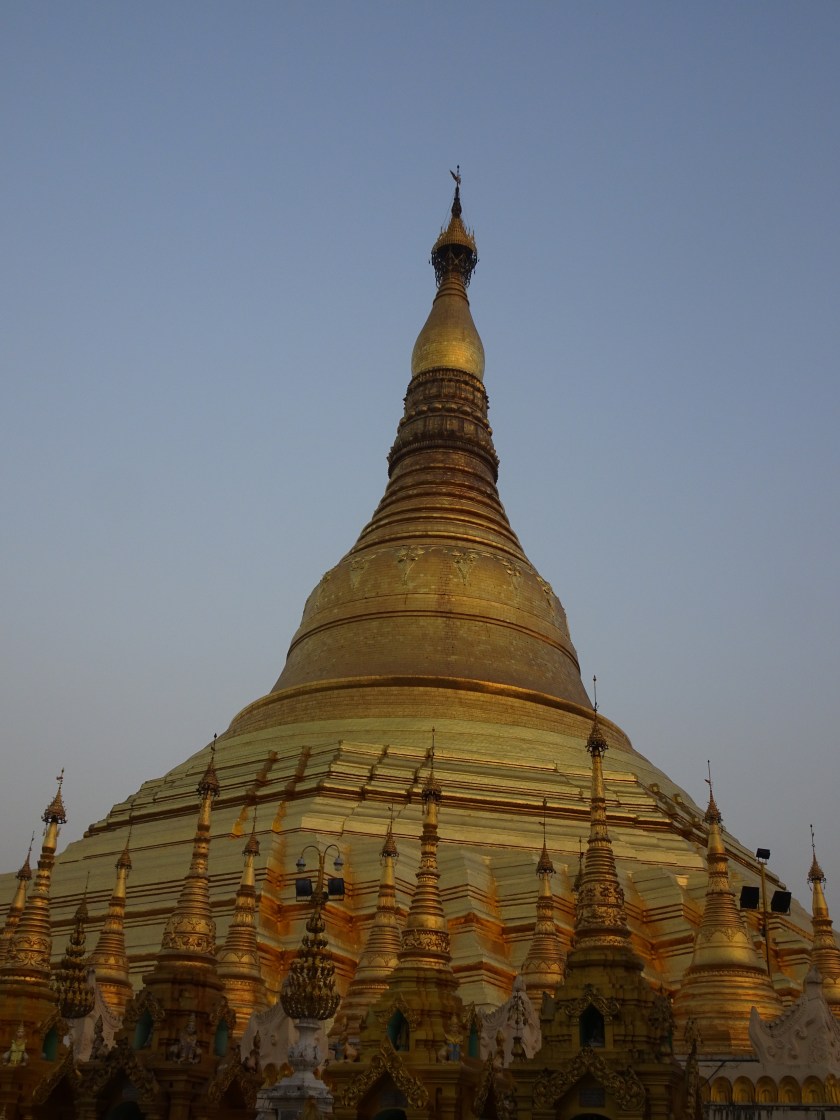
Once we returned to the main train station after a stimulating three hour ride, we made our way to the Shwedagon Pagoda, one of the most famous pagodas in the world.  Gleaming in gold and decorated with diamonds, the huge Shwedagon Pagoda is a spectacular work of Burmese temple architecture and is the holiest Buddhist monument in all of Myanmar.   It is believed to enshrine eight hairs of the Gautama Buddha as well as relics of three former buddhas.  The original height of the pagoda was 66 feet.  From the 14th century onward, successive monarchs in Myanmar rebuilt or regarded it until Shwedagon reached its present height of 326 feet.  It is decorated with 3,154 gold bells, 79,569 diamonds as well as other precious stones.

We were told it was best to visit at sunset so that’s what we did and it sure didn’t disappoint.  The pagoda colors transformed from a flaming crimson, to a burnt orange until it finished with an ever so splendid golden shine.  It was pretty pretty pretty perfect, stupendously stunning, impeccably impressive.  There was just so much gold everywhere you looked.  Thanks to Kanye West, all I kept singing was “I ain’t sayin’ she a gold digger”…
DSC07037

DSC07026

DSC07038.jpg

DSC07046

DSC07057

DSC07061

DSC07065.jpg

IMG_1281.JPG

DSC07080.jpg

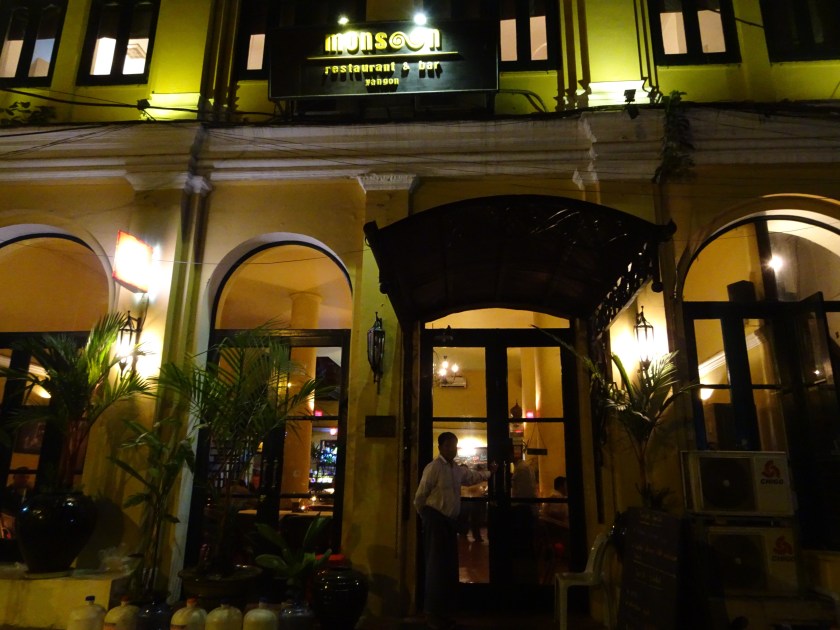
We ended this epic day with a delicious dinner at Monsoon (thanks Mark for the recommendation!).  Great food, great vibe and great cheesy American music playing on a very short loop in the background.
DSC07094

DSC07093

Day 4 – March 25th 

Unfortunately, Vinny woke up feeling sick again so we laid low for most of the morning.  I think we might have overdone it yesterday.  Oops, I’m not that good of a nurse apparently.
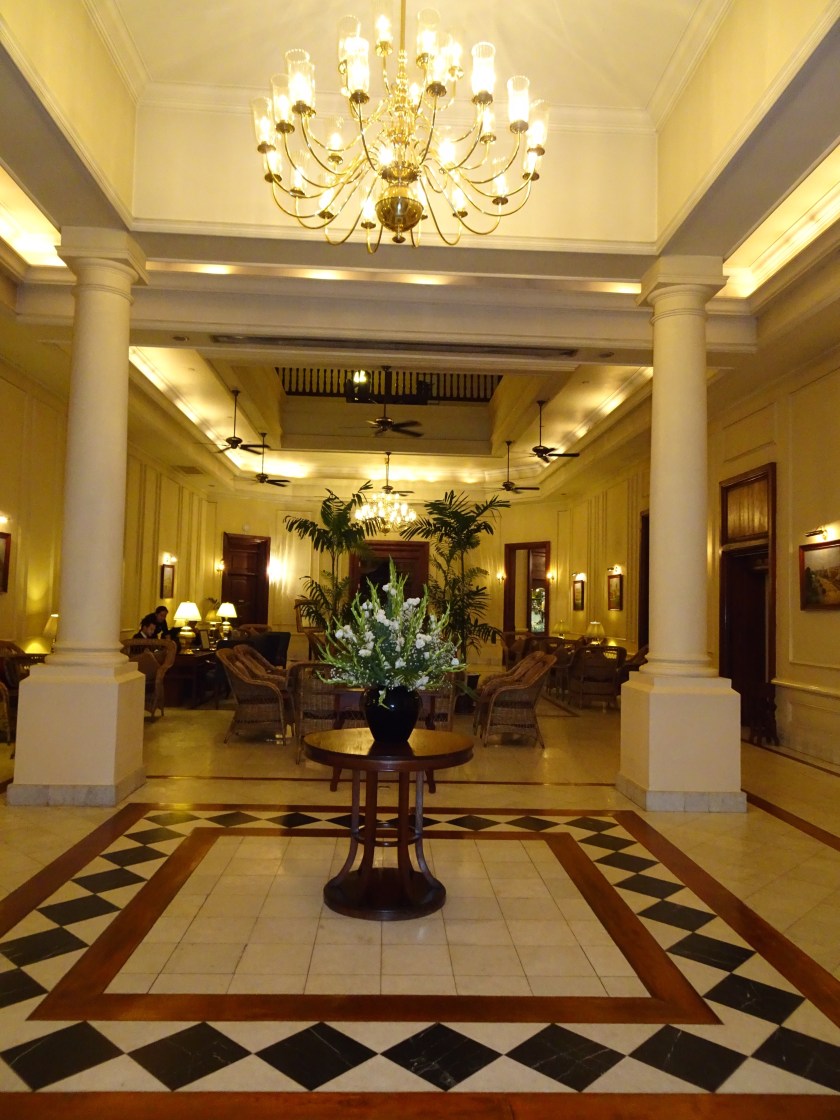
Around 5pm, we hailed a cab and headed to The Strand Hotel for some high tea.  Pinkies up always.  The Strand Hotel is one of the oldest hotels in Yangon, built in 1901, and remains one of Southeast Asia’s few grand colonial and most awe inspiring architectures.

DSC07096

DSC07103

DSC07108

After we sipped on tea and enjoyed the beautiful decor of The Strand Hotel, we decided to have an earlier dinner since we didn’t have lunch.  But as soon as we walked outside, I got this not so pleasant feeling in my stomach.  In a snap of a finger, I was utterly nauseous.  That’s weird.  I felt totally fine when I sat down and now an hour later, I feel not so fine.  Maybe I’m just hot and hungry?  The Union Grill was a quick ten minute walk so in no time I will shove my face with some yummy food and be 125% again (why settle for average).

DSC07111

DSC07110

However, that wasn’t the case.  About fifteen minutes after sitting down, I abruptly rushed to the bathroom to throw up, twice.  Ummm, what is going on with us?  I couldn’t fathom eating a meal so Vinny finished his as quickly as possible and we unwillingly went back to our hotel room.  For the next few hours, I set up shop in the bathroom.  As you can imagine, both of us were obsessively trying to determine what this could be.  We both had the same sickness yet two days apart.  I guess we will never know but the unanimous decision was some kind of stomach bug.  Not fun.

Day 5 – March 26th

I woke up not feeling horrible but not feeling like my energetic self either.  We were scheduled to take an overnight bus tonight to Bagan so we had the entire day to explore but I couldn’t get out of bed.  Since we weren’t leaving until 8pm, we paid $15 USD to keep the room past 4pm so I could rest in the air conditioning.  We ended up in Yangon for five nights (originally planned for three nights) and five full days but could only really enjoy one and a half of them.  Such a bummer.  Oh well, moving on.

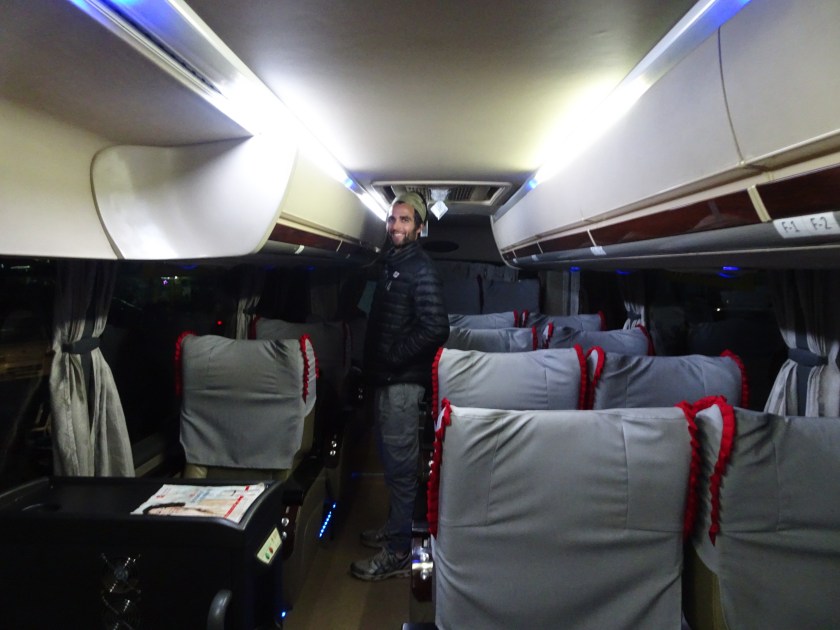
Around 7:45pm, we boarded our overnight bus with JJ Express from Yangon to Bagan, which cost $19 USD per person.  There was no bathroom, which terrified me in case I got sick again but they did have reclining chairs, a blanket and a pillow.  Hopefully I will just shut my eyes and wake up in a new city, feeling like a new me…

DSC07120.jpg

DSC07122.jpg

DSC07126.jpg


Paro, The Tiger’s Nest

On Friday, March 18th, we arrived at Bhutan Mandala Resort in Paro around 5:30pm after a four hour drive from Punakha.  The past few days have been absolutely incredible but they have also been intensely nonstop.  Our eyelids weigh more than a Japanese sumo wrestler right now and our bodies feel like a melted container of jello, all over the place with no substance.  Since tomorrow is the big Tiger’s Nest hike, we treated ourselves to some much needed down time in our room, grabbed some dinner at the hotel and called it a night by 10:30pm.  We wanted our mind, legs and stamina to be 110% by morning.

phoca_thumb_l_gallery7big.jpg

DSC06917.jpg

Today, March 19th, we met Kezang and Tenzin in the hotel lobby around 9am and drove about twenty minutes to the base of the Taktsang Monastery, otherwise known as Tiger’s Nest.  This monastery is one of the most important cultural icons of Bhutan, the granddaddy of them all and what we’ve been “training” for over the last few days.  Now that I have explained a few of Bhutan’s out-of-this-world mythological beliefs such as the phallus warding off evil and the Temple of Fertility allowing those challenged to conceive, let me now tell you the history behind this specific establishment.  According to legend, Guru Padmasambhava (Guru Rinpoche) reached the temple site of Paro Taktsang in the 8th century by flying on the back of a tigress from Tibet. Guru Padmasambhava was a Brahmin royal who spread Tantric Buddhism throughout Bhutan in the 700’s.  The name “Taktsang” literally means Tiger’s Lair and was derived when the people in the locality came across a tigress residing in one of the caves. Rinpoche meditated in thirteen small monasteries or ‘tiger nest’ caves, of which Paro Taktsang is the best known. It is said he meditated in the cave on the mountain for three years, three months, three weeks, three days and three hours. After completing his meditation, Guru Padmasambhava subjugated the eight categories of evil spirits and converted the Bhutanese to Buddhism. Today, he is viewed as holy as the Buddha himself, regarded as the Second Buddha, and a guardian spirit of Bhutan. His followers are convinced he is still alive and active but in another form, as Rainbow Body.  So there you have it.  Another wild concept strongly believed throughout this fascinating country.  Of course a tigress flew up there, how else would one have arrived back then?  At least now they have paths for us tourists because riding a tiger probably isn’t considered humane anymore.  Duh.


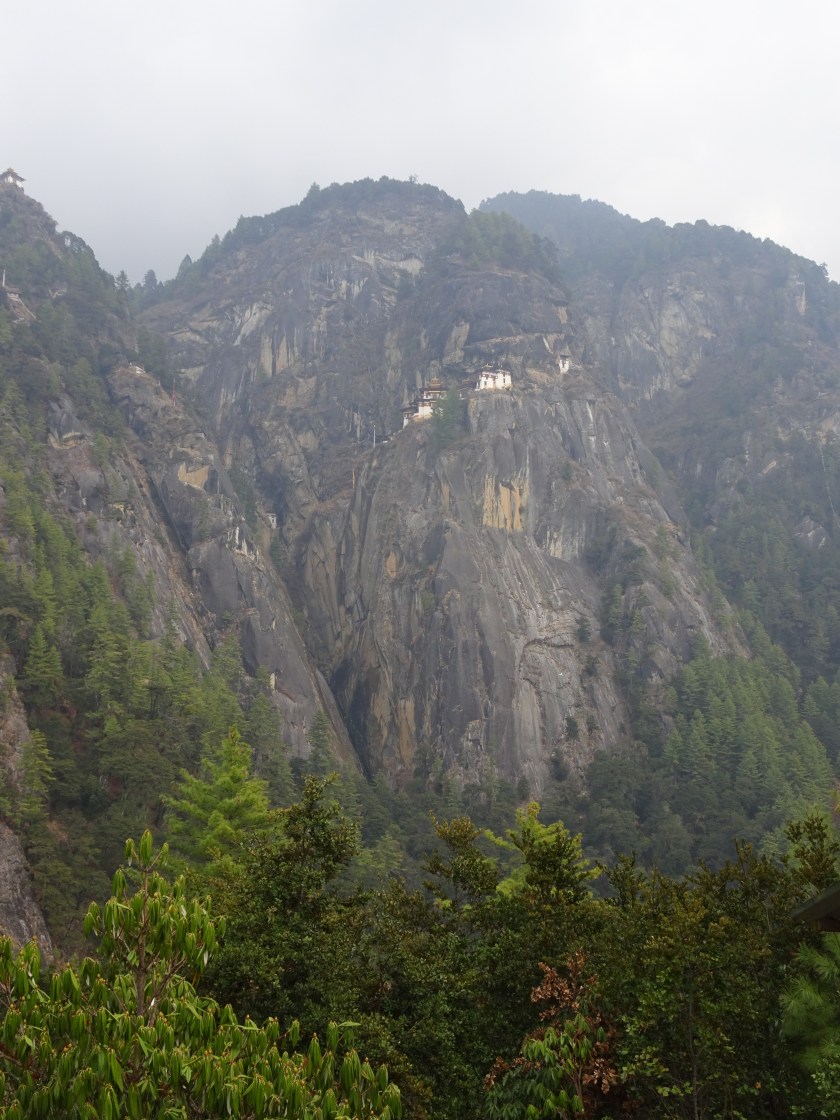
This is where we started. Down on the ground, with only two tiny white dots playing peek-a-boo with you high in the mountains yelling catch me if you can.  From this point, I kept thinking “there’s no way you can walk to that”.  It seemed as though the monastery was floating at an unobtainable level.  But after a little while, you slowly realize it is obtainable and I can’t wait to add this to my collection of memories.

DSC06556

The path wasn’t paved nor was it flat.  It was rocky, dusty, and all uphill but without sounding cheesy or cliche (although that is my speciality), it really added to the overall experience.

DSC06559

DSC06704.jpg

Since Monks live at The Tiger’s Nest and there is a cafeteria mid-way through the hike, various supplies such as food, water, etc. need to make its way up somehow.  Us humans aren’t really equipped for that sort of weight so they use donkeys.  And, for those folks that are a little older or not in that great of shape or just plain lazy, they can pay a pretty penny to ride a donkey half way but after that, it gets a little too steep and a little too narrow to depend on an animal you can’t fully communicate with.  What an ass.

DSC06580

DSC06718

Breathtaking (literally because of the altitude) scenery every next level you reached…

DSC06585

DSC06693

DSC06582.jpg

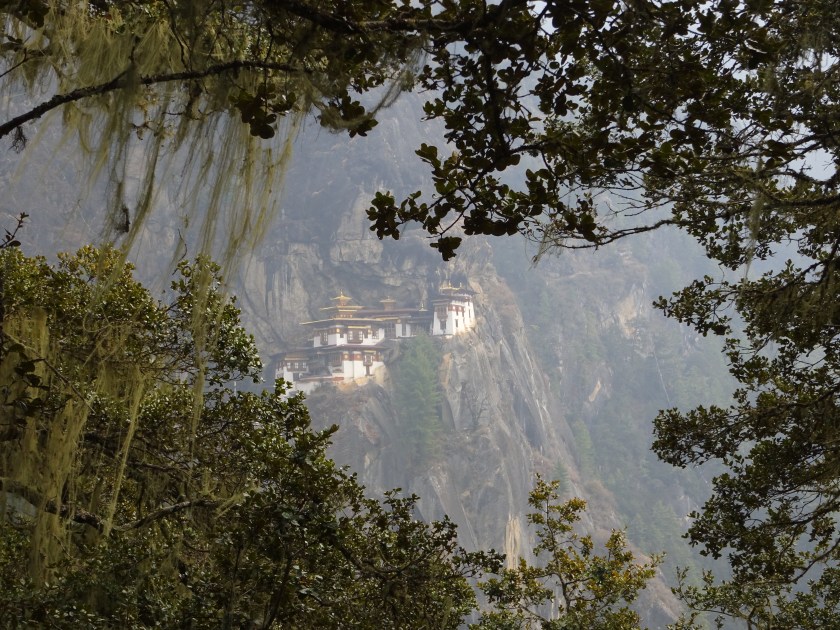
And with every turn, you could see the Tiger’s Nest getting closer and closer, bigger and bigger, brighter and brighter…

DSC06588

DSC06592.jpg

DSC06589

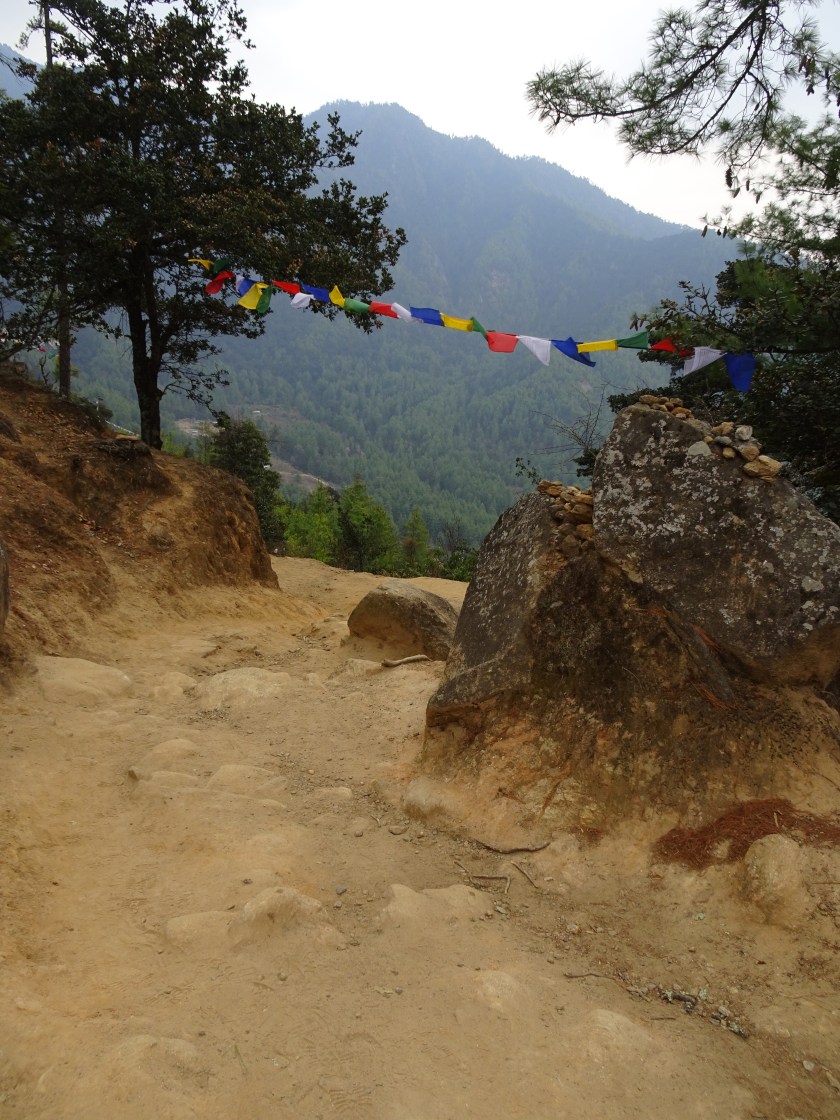
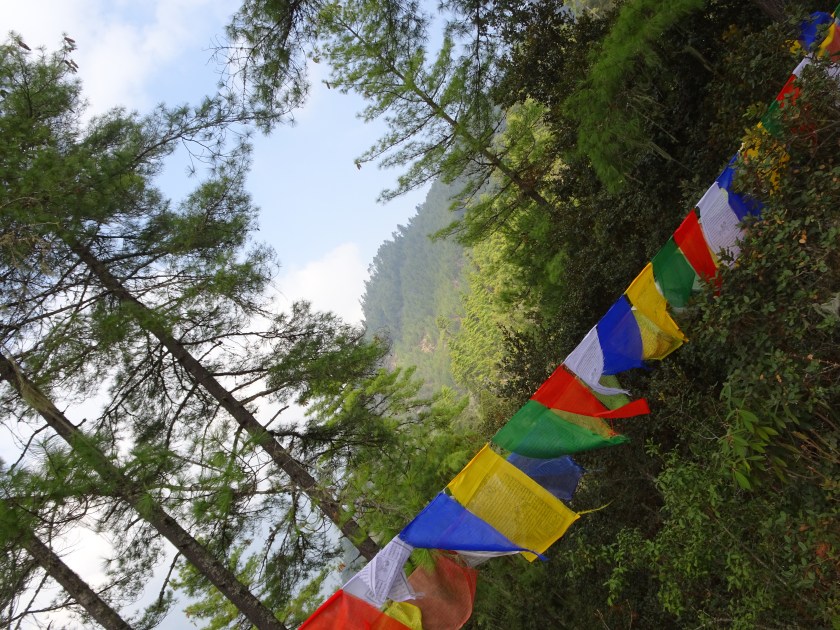
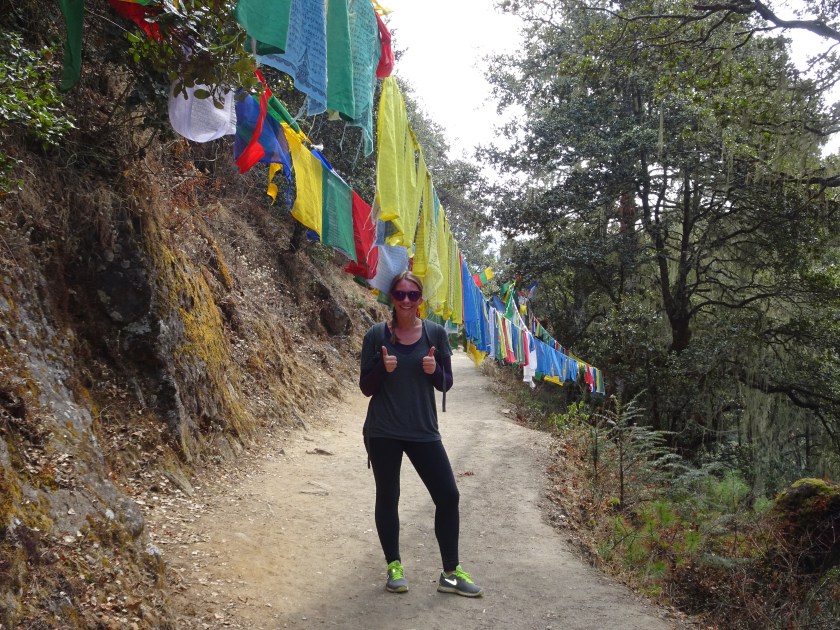
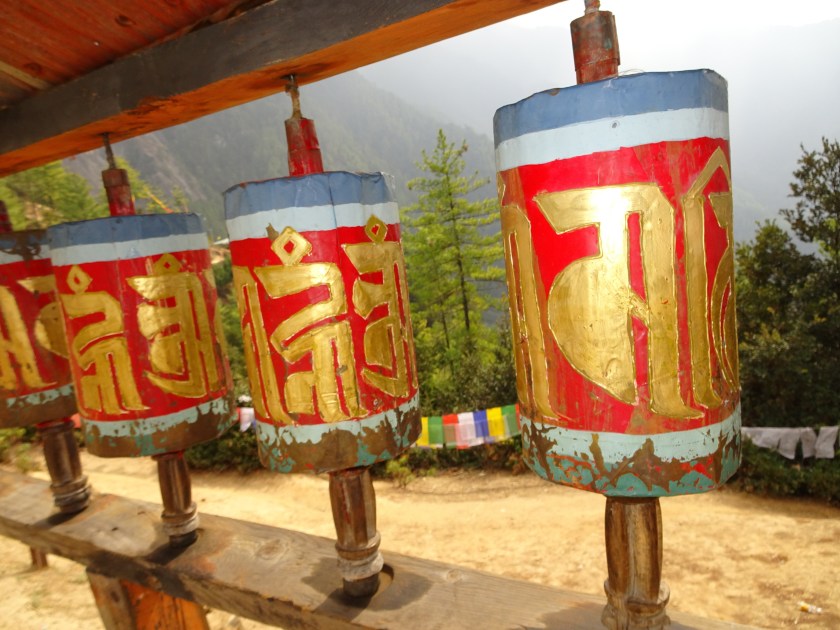
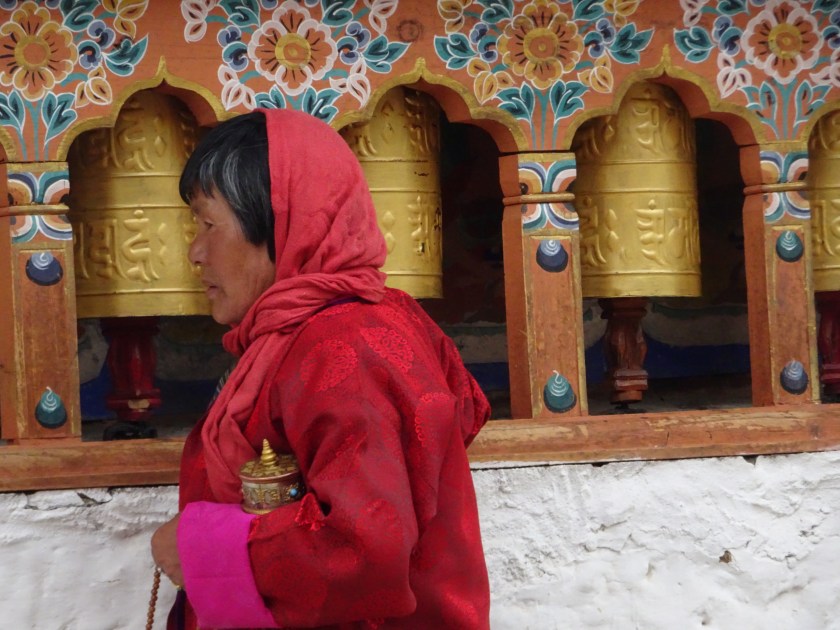
Prayer flags and prayer wheels were everywhere along the way…

DSC06599

DSC06581

DSC06605

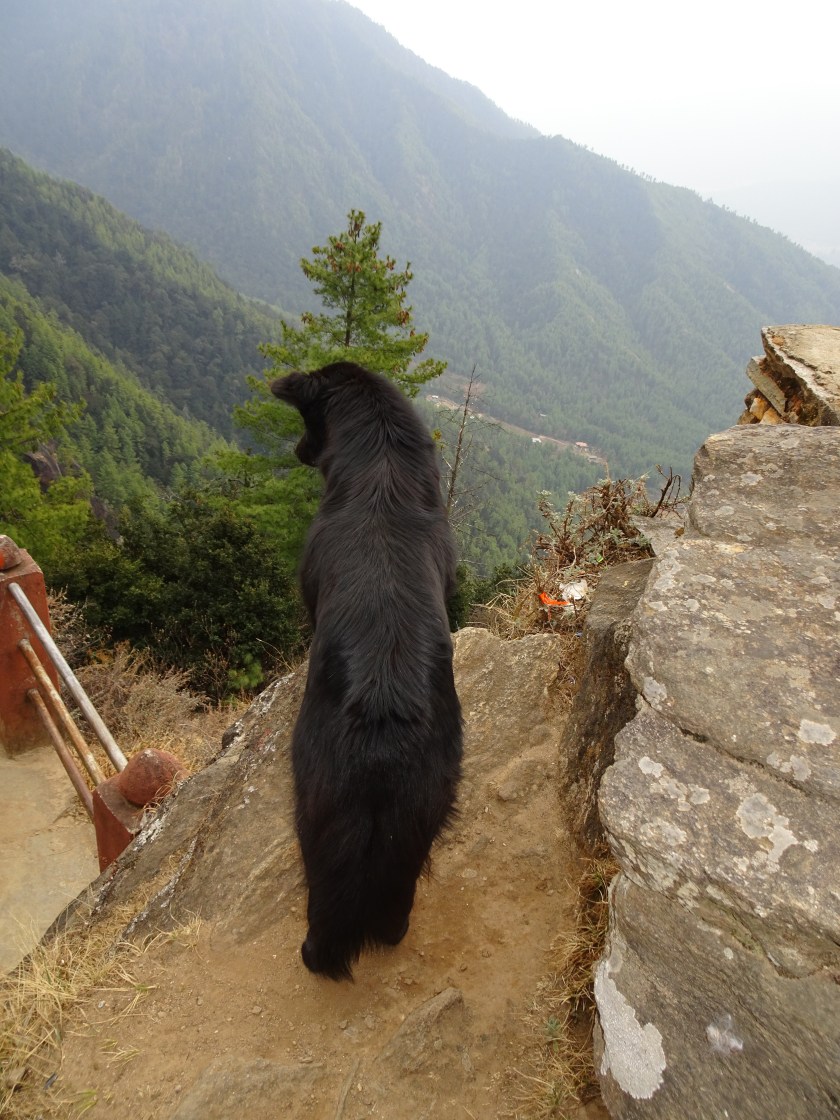
There was also a guard dog, making sure everyone is safe…

DSC06687

After about an hour and forty five minutes of huffing and puffing uphill, we came to an official photo opp of the Tiger’s Nest.  This was the closest we’ve seen it and oh boy was it absolutely stunning.  It literally hugs the side of the cliff over 10,000 feet above sea level.  The green forest trees mixed with the brown mountains mixed with the red, white and gold architecture leaves you in complete and utter awe.  I could have stayed at this point all day and just stared.  One of the most beautiful creations I’ve ever witnessed in person.

IMG_1253.JPG

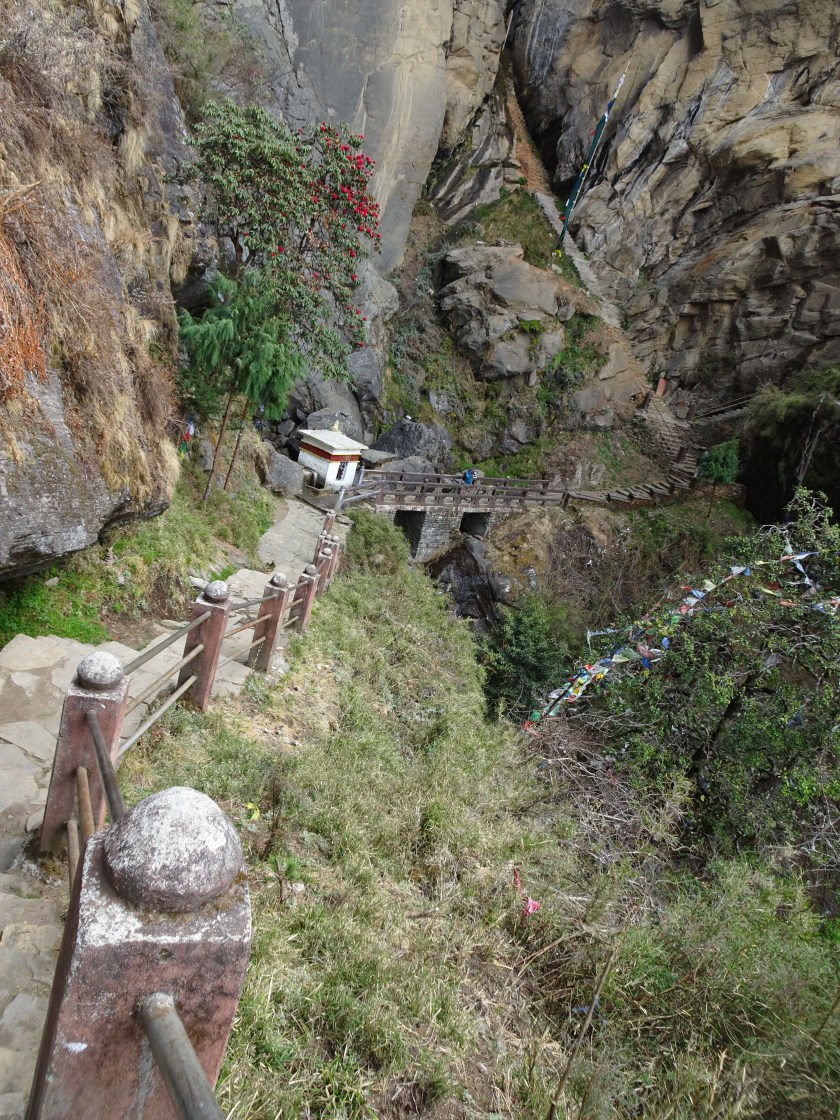
Now that we’ve snapped almost a hundred photos, we then had to slowly and carefully go up and down over 850 steps before arriving at the entrance.  If you are afraid of heights, this probably isn’t for you.  One trip on your shoe lace and your done.  There isn’t much room for a careless mistake and unfortunately, a 54 year old woman from Thailand learned that the hard way.  In January 2015, she was taking a photo, lost her balance and fell over the side.  I think then there weren’t any railings but now they have added them to avoid the same situation from occurring again.  Very tragic.

DSC06645

DSC06654.jpg

DSC06667

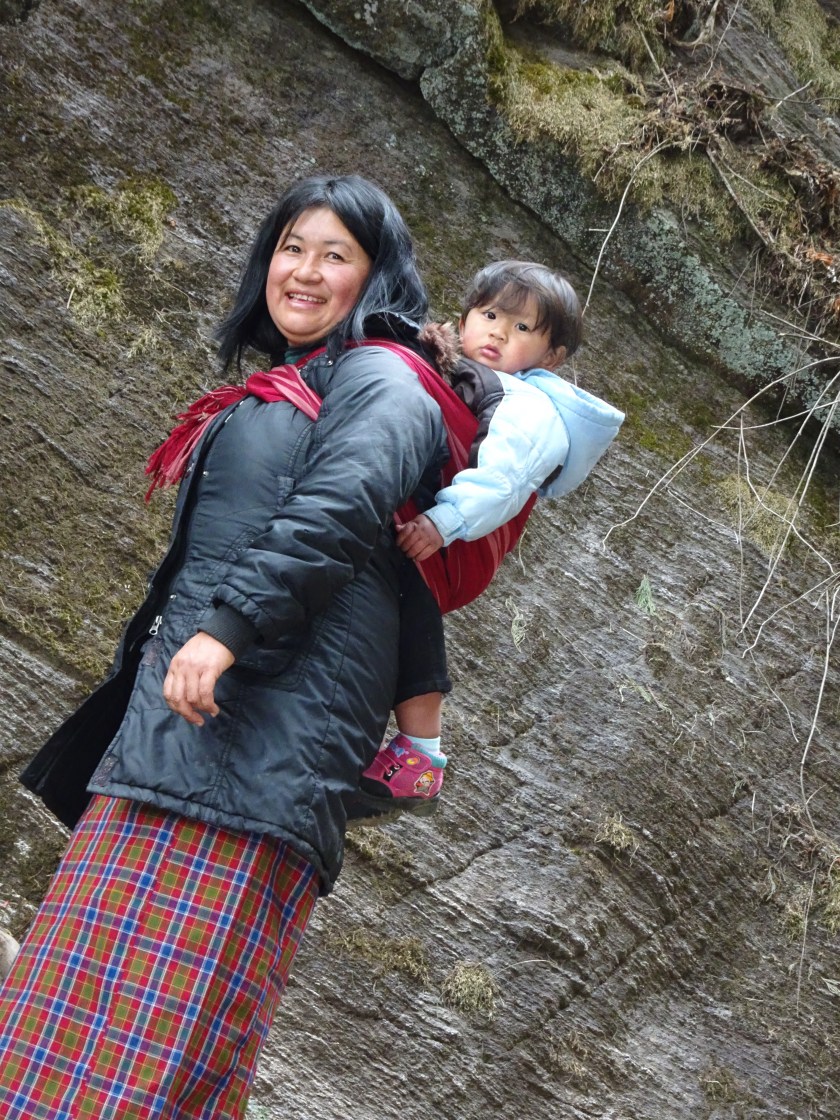
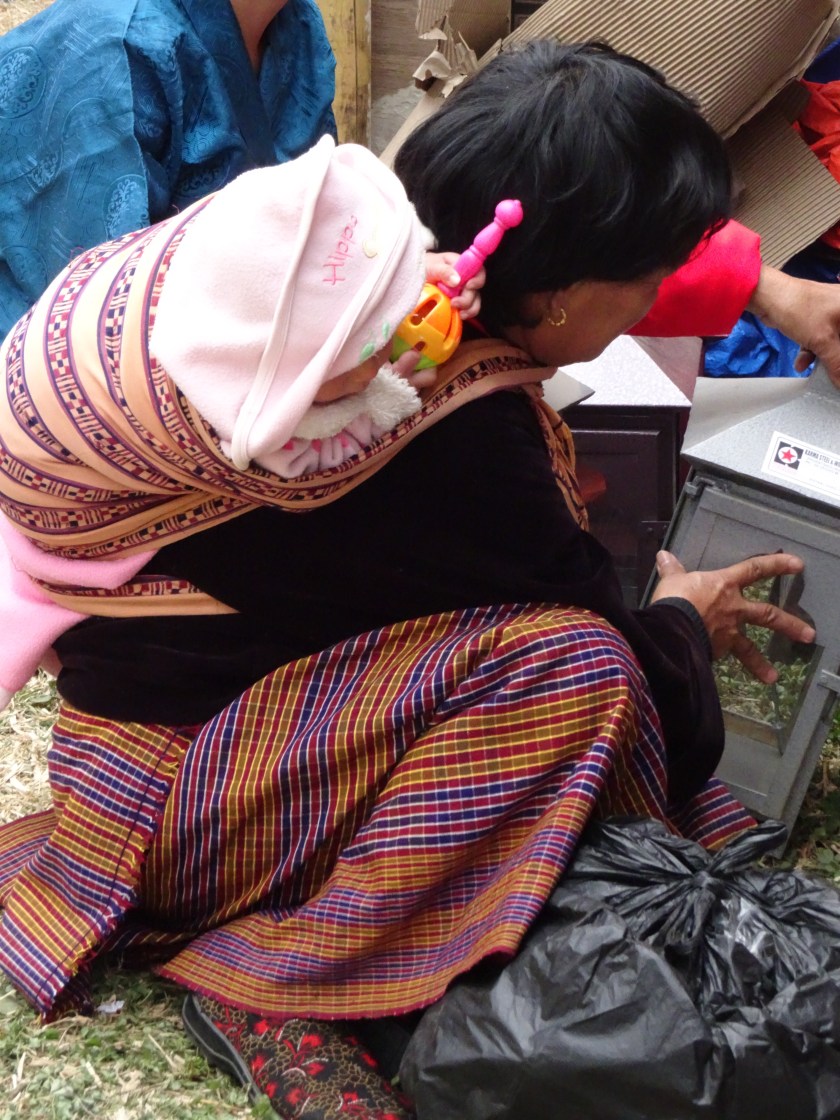
To hike the Tiger’s Nest is a challenge in itself, I couldn’t imagine doing it with a baby on my back, only being supported by a piece of cloth and still managing to smile for a random tourists photo…

DSC06673

I was pretty hot and sweaty the entire way up but once we reached the top, the weather drastically changed.  It was absolutely freezing and fairly windy.  My nose was as red as Rudolph’s, my toes and fingers quickly became numb and with every heavy breath I let out, it was as if I was exhaling smoke from a cigarette.  From this point on, we couldn’t take any photos.  In fact, we had to check all of our belongings before entering.  For the next hour, we visited eight different temples, all holding such a significant importance.  Kezang was mentioning that this is one of the holiest Buddhist monasteries in the world and that every Buddhist dreams of being right where we are standing at this very moment.

One the way back down, we stopped at the cafeteria and had some tea and biscuits.  Going up was much easier for Vinny and going down was much easier for me, although my left knee cap was still bruised from my bike fall in Mumbai.  We always seem to be on opposite levels but somehow it works (or at least I think it does).


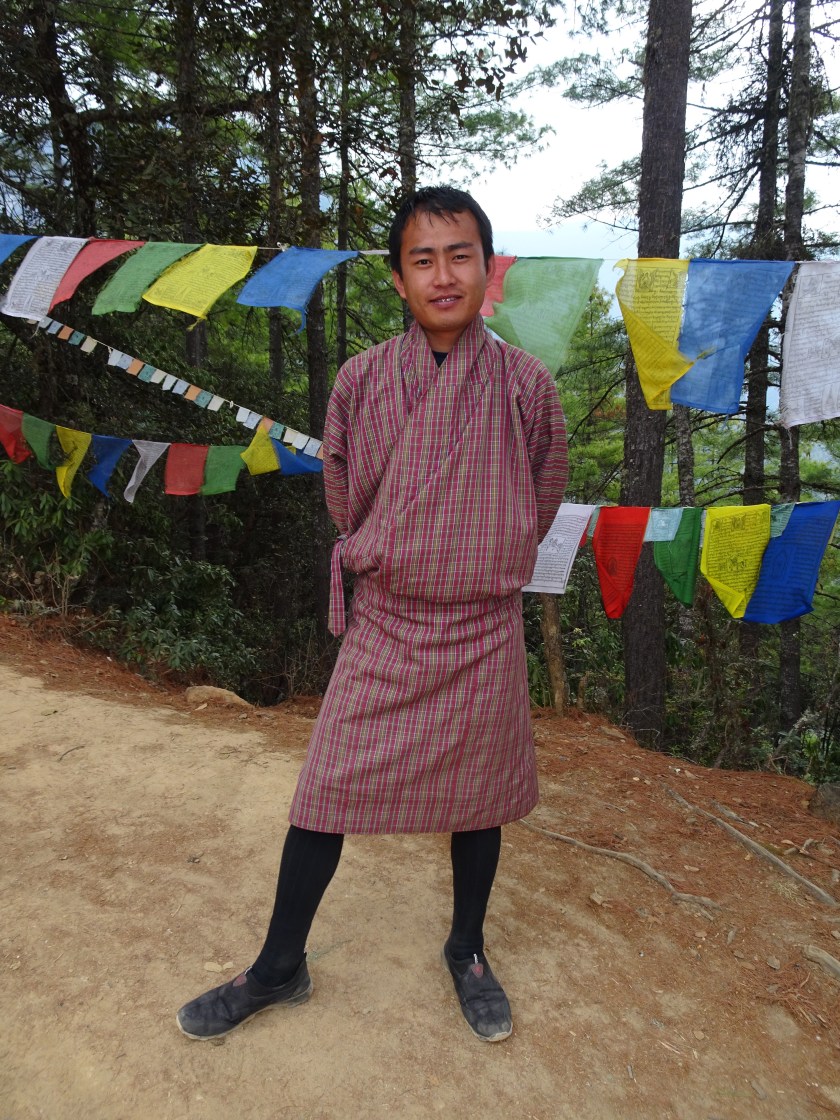
Here is our guide, Kezang, in his traditional Bhutanese attire.  He did manage to swap out his nice black dress shoes for some more Tiger’s Nest appropriate footwear.

DSC06703

We were on such a high after this experience.  It would have been totally okay with us to call it a day at this point because nothing could really ever match, or even come close, to what we just saw.  However, with limited time in Bhutan, there’s no rest for the wicked.

Next on our agenda was Kyichu Lhaknang, one of the oldest temples in Bhutan.  It is widely believed to have been built in 659 by King Songtsen Gampo of Tibet, to pin down the left foot of a giant ogress who was thwarting the establishment of Buddhism into Tibet.  As you enter the intimate inner courtyard you’ll see a mural to the right of the doorway of King Gesar of Ling, the popular Tibetan warrior-king, whose epic poem is said to be the world’s longest.  The inside of the temple, which we couldn’t take photos of, supposedly still has its original floors, made from real wood (would love these in whatever house I might or might not own down the road) and original paintings on the walls, which are very much faded now.

DSC06720

DSC06725

DSC06721

DSC06731

DSC06723

DSC06732

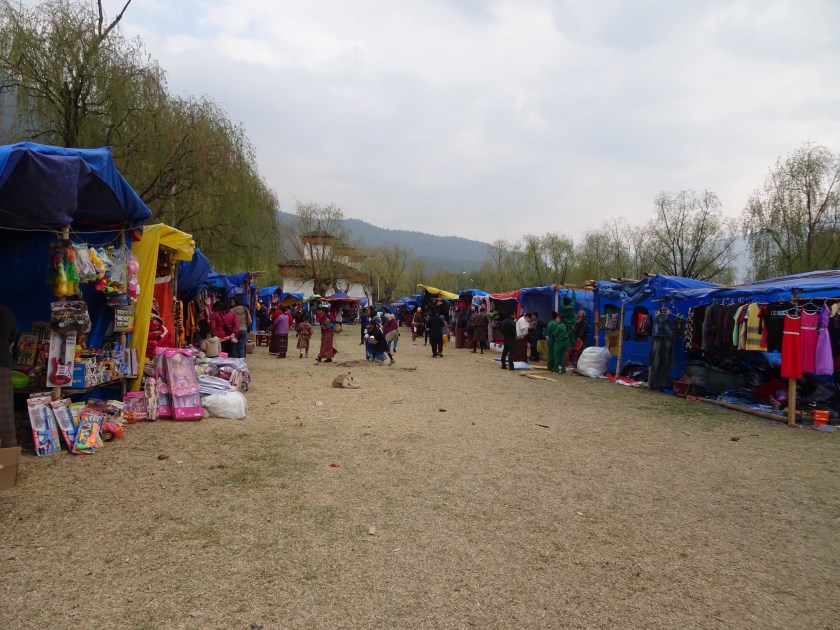
Then we walked around the actual town of Paro.  Since the annual Paro Tsechu Festival began today, there were a ton of activities happening.  There was a flea like market that had at least twenty tents selling random stuff, including a balloon man – you can’t have a festival without a balloon man.  And various craft stores along the main street had decorated phalluses in their windows for sale.  Fascinating.

DSC06736

DSC06738

DSC06739

DSC06741

DSC06750

DSC06752

Last but certainly not least, Bhutan Swallowtail treated us to a very special evening at a traditional farmhouse.  This farmhouse has been with the same family for over 300 years.

DSC06755

DSC06763

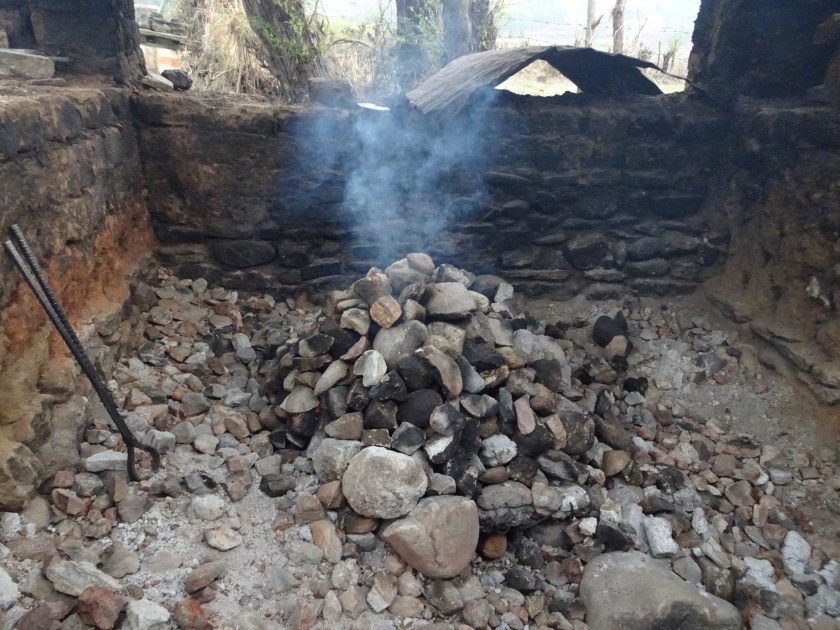
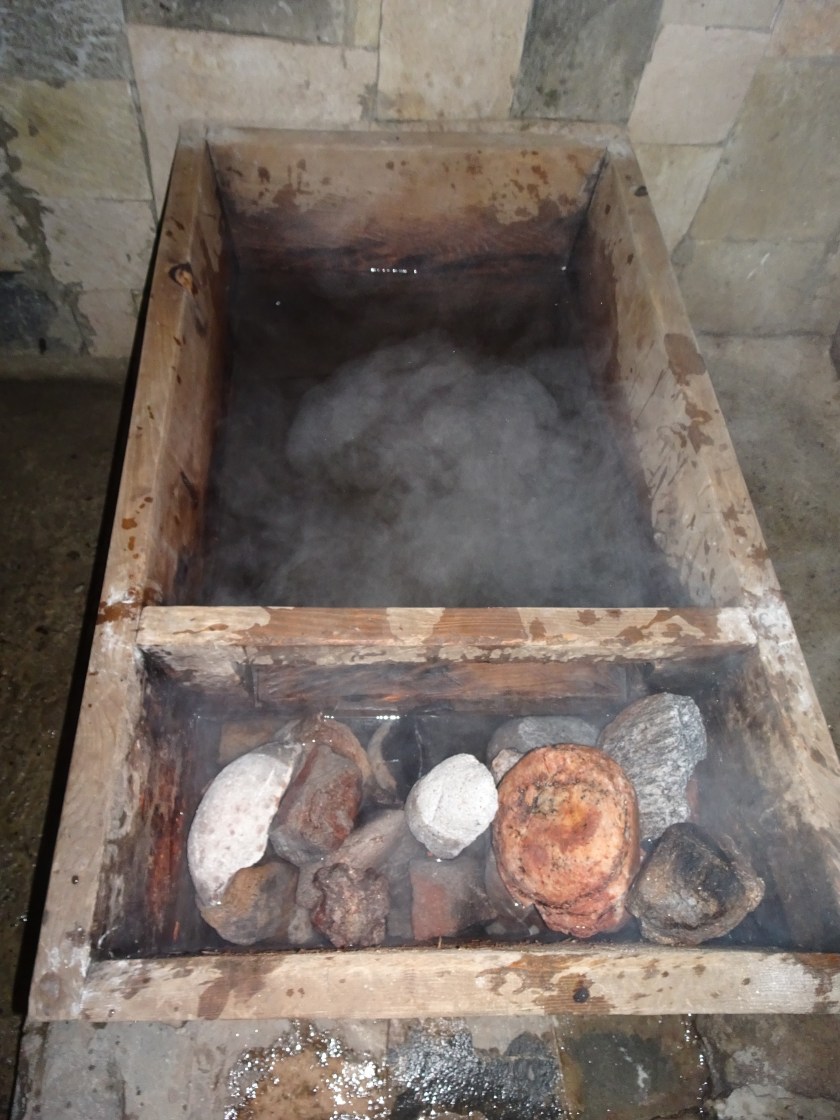
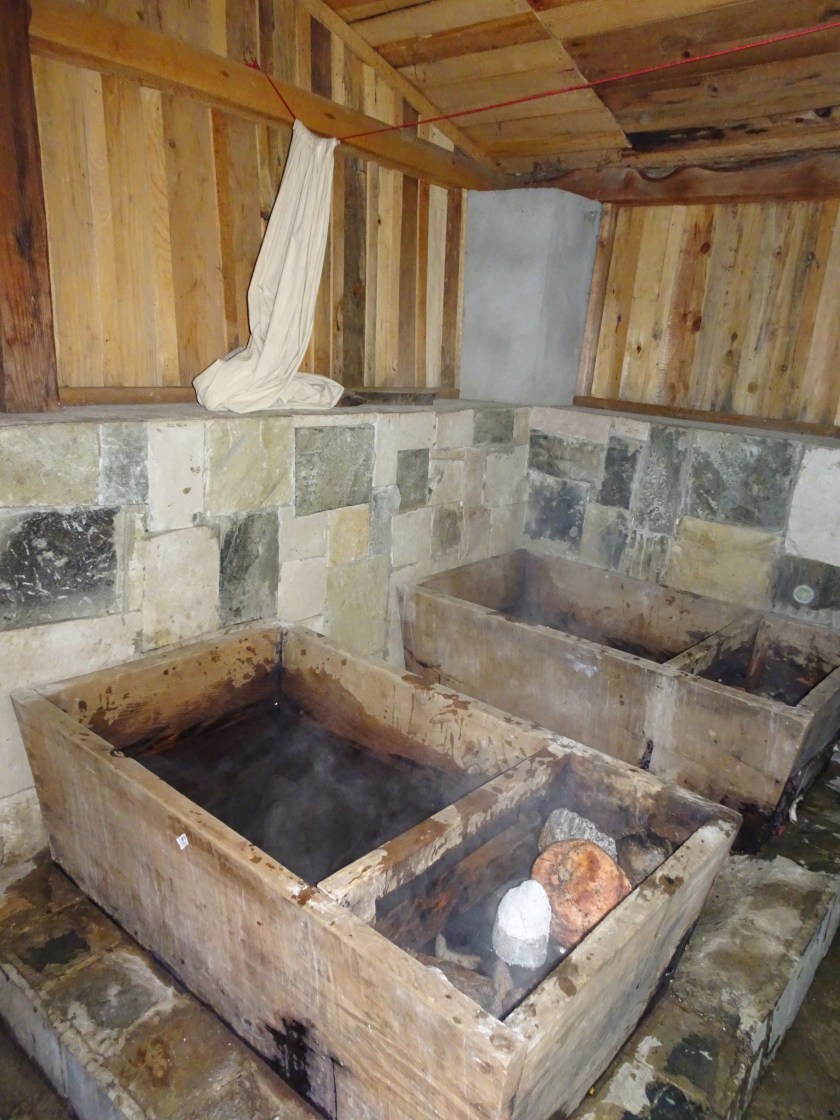
To help our bodies recover from the Tiger’s Nest hike (not that it was that strenuous at all), they set up a traditional hot stone bath for us, which is widely practiced in Bhutan and is also a method to overcome various complications and illnesses.  This consisted of heating the river rocks with fire then moving them into the water of the wooden made bath, which essentially is supposed to release key minerals and relieve deep-set aches of the body.  It was just Vinny and I in the room.  We closed our eyes and enjoyed this somewhat pampering, extremely relaxing feeling for about forty five minutes.  Whenever we felt the water was getting cold, they would bring us more stones.  Every time the hot stones would enter the bath, it sizzled dramatically as if they were serving chicken fajitas (or beef fajitas or shrimp fajitas, you get the point).  And when we came out, our bodies had so much steam escaping them.  What a neat concept.

DSC06765

DSC06769

DSC06775

DSC06777

The farmhouse family hosted a handful of us for a traditional Bhutanese dinner after our hot stone baths. We all sat on the floor, in a semi circle and ate a home cooked meal.  People were representing countries from all over the world including Japan, Netherlands, Germany, Sweden, London, USA, and obviously Bhutan.  The woman in the middle of this photo pouring the butter tea is part of the family who owns this farmhouse.  She is the eighth generation to live there and her kids are the ninth generation.

What an incredible, authentic, memorable day and night we had.  I literally feel like a flying tigress, I’m that high on life right now.

DSC06786

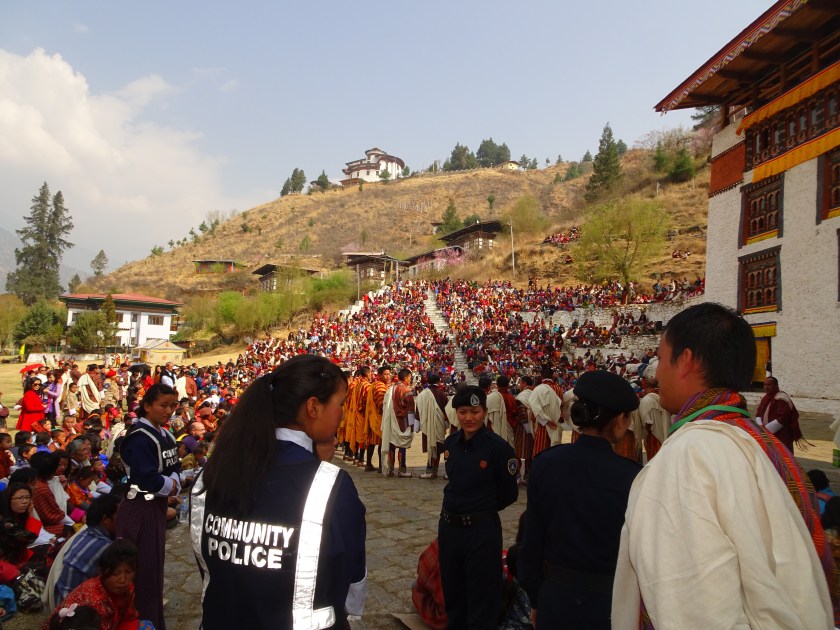
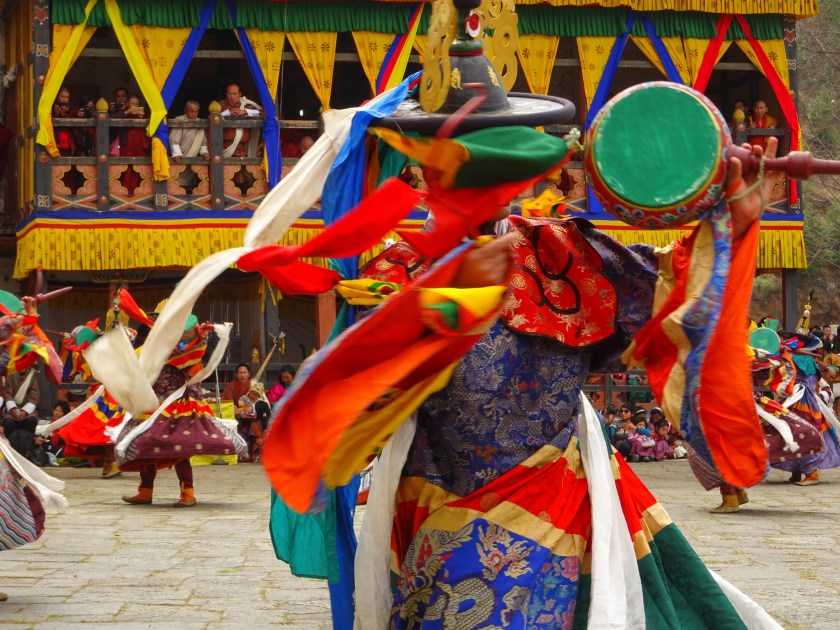
The next day, March 20th, was our last day in Bhutan and what better way to celebrate it than with the Paro Tshechu Festival. Featuring dances performed by trained monks and laymen in amazing masks and costumes, we were told by Bhutan Swallowtail that Tsechus (festivals) are one of the best ways to experience the ancient living culture of Bhutan.  A Tsechu is a Buddhist festival in honour of Guru Rimpoche, the saint who brought Buddhism to Bhutan and the one who mediated at The Tiger’s Nest (if you don’t know what I’m talking about, you obviously didn’t read the history I explained in great detail earlier.  Shame on you). Thousands of locals and tourists come from all over the country to witness this festival.  The overall vibe was nothing like we’ve ever seen before.  People were so calm, captivated, happy and of course, dressed in their very best Bhutanese attire.

DSC06790

DSC06794

DSC06795

DSC06802

DSC06803

DSC06804

DSC06808

DSC06822

DSC06826

DSC06837

DSC06838

DSC06871

DSC06878

DSC06910

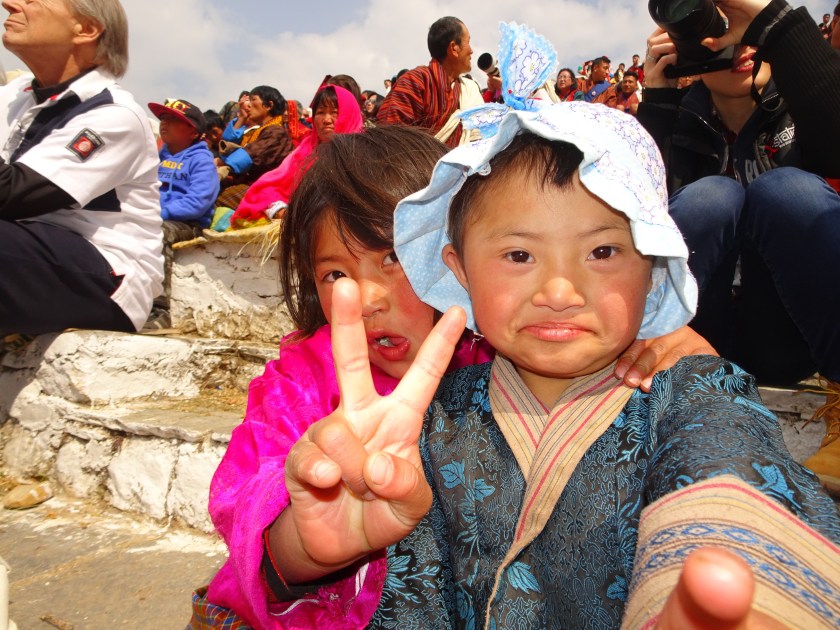
These adorable girls came up to talk to us because they wanted to practice their English.  They asked if we loved our King as much as they loved their King and when I tried to explain we have Presidents that are elected, not Royalty that is inherited, they didn’t quite understand that concept.  But they were real sweet and I was quite impressed with their vocabulary.  Easterners love to give the peace sign so I played along.

DSC06912

That night, Bhutan Swallowtail hosted nineteen of us for dinner outside by the river.  There was a bon fire (it was sooooo cold!) and all the guides taught us some local songs and dances.  The alcohol was flowing (the Bhutanese love to drink!) and everyone was slowly loosening up with every sip.  It felt like sleep away camp almost.  What a fun night and a wonderful way to end such an unbelievable week in such an unbelievable country.

DSC06922

12901188_1016167881837502_5259710652799301604_o.jpg

12901214_1016168168504140_851812383240949081_o.jpg

12792247_1016168031837487_5959181834785709738_o.jpg

DSC06926

Bhutan is as close to heaven as you can get while still being alive.  Every day for seven days, we experienced the natural charm of the first country where Gross National Happiness is deemed more important than Gross National Product.  It’s a fairytale kind of land sprinkled with the perfect amount of joy, contentment, respect, happiness and an overall genuine appreciation for life.   Everywhere else in the world should strive to have the same vision and values as the Bhutanese.  It’s hard to believe a place like this exists but it does and we were lucky enough to experience it first hand.

As the locals say, Log jay gay, meaning goodbye and we will meet again!


Punakha Valley

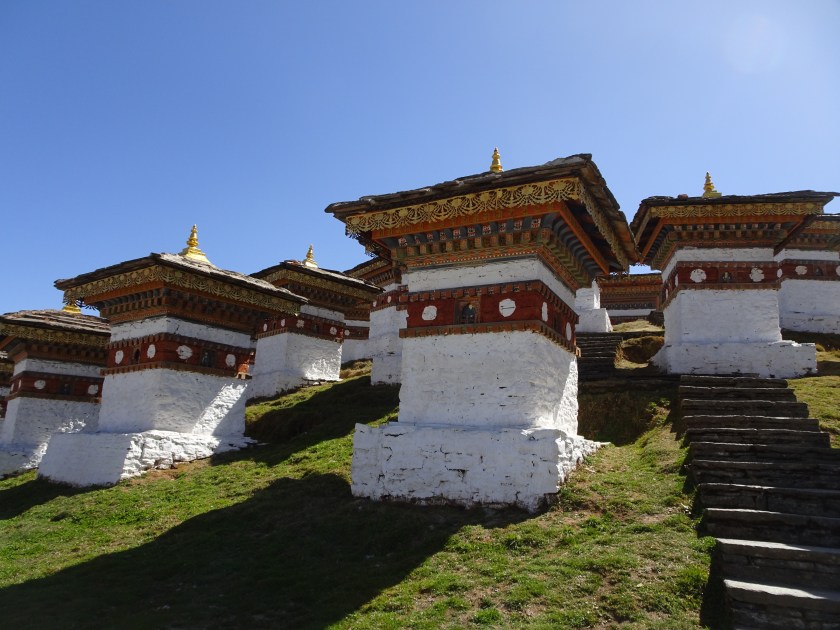
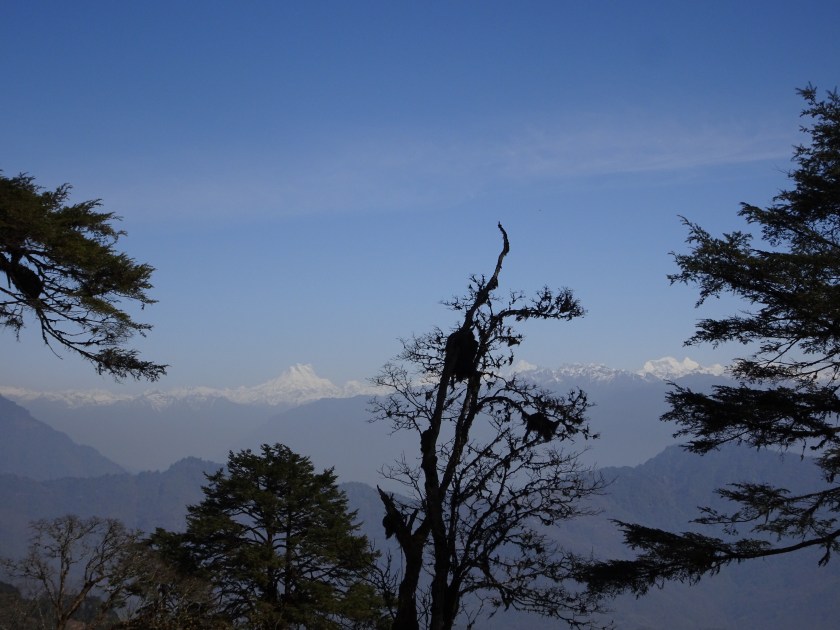
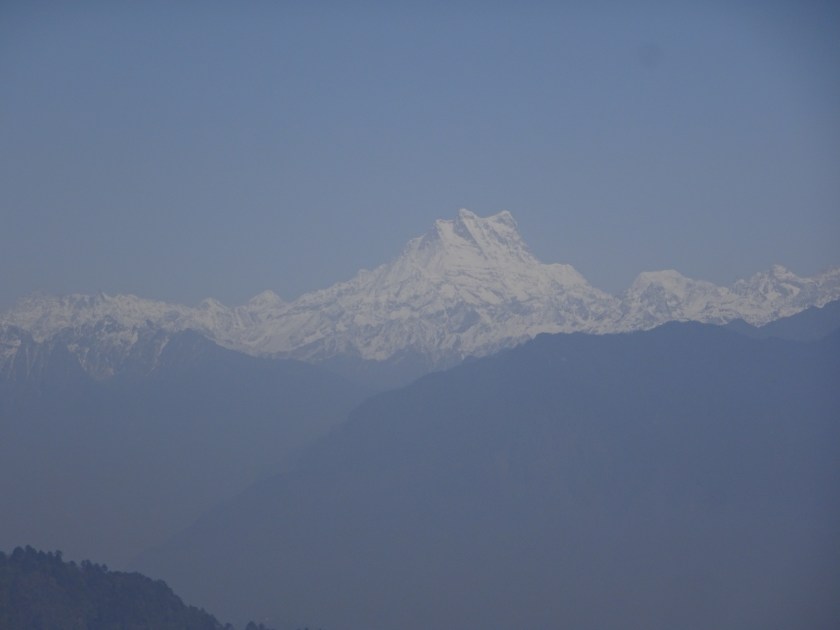
On Thursday, March 17th (St. Patrick’s Day but that means nothing here in Bhutan – they are basically leprechauns dancing on a rainbow everyday of their life) we slowly made our way to the Punakha Valley.  The road was unpaved, dusty and extremely bumpy, much like Nepal, which was kind of refreshing to know Bhutan isn’t always perfect.  Our first stop on this three hour road trip was the Dochula Pass, high on top of a mountain offering a stunning 360 degree panoramic view of the Himalayas. The snowcapped mountain peaks formed a majestic backdrop to the tranquility of the 108 chortens (stupas), built in memory of the Bhutanese soldiers killed in the 2003 war against insurgents from India.  We actually met a man from India who has been visiting Bhutan since 2005 and mentioned this was the clearest day he’s ever seen. Luck was definitely on our side. We could effortlessly point to Gangkhar Puensum, the highest mountain in Bhutan and a strong candidate for the highest unclimbed mountain in the world with an elevation of 7,570 meters or nearly 24,835 feet.  The air was so cool, so clear, so clean and so crisp.  It was what I kept referring to as the quadruple C.  And if you add me in there, it would be the quintuple C (because my last name is Cantor, get it?).

DSC06266

DSC06258.jpg

DSC06270

DSC06261

DSC06271

DSC06279.jpg

DSC06290

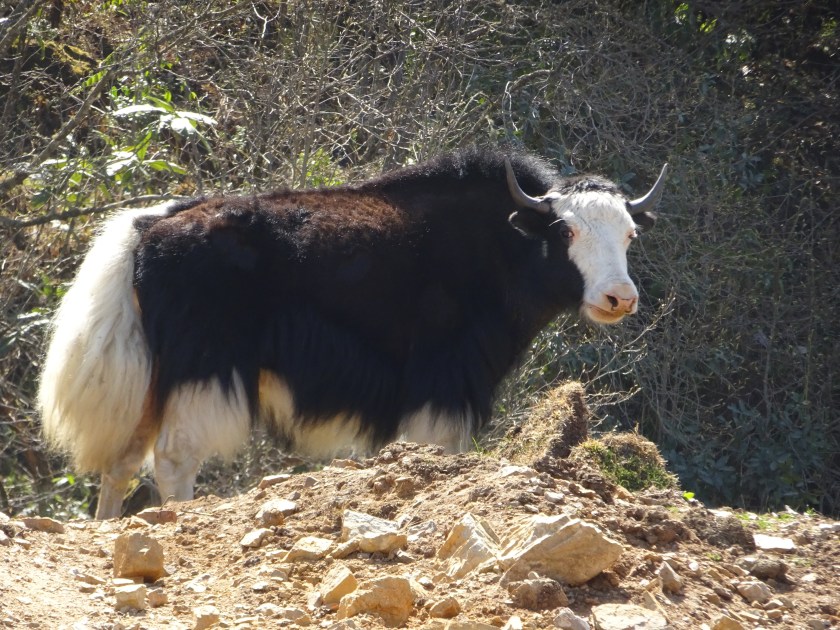
After we took in the scenery, we piled back in the car and continued on our journey.  About fifteen minutes later, Kezang and Tenzin spotted some yaks on the side of the road so I of course asked to stop and capture these unique animals in action.  I don’t know about you, but I’ve never seen one up close and personal.   Maybe that’s because yaks cannot survive below 3,500 meters (10,500 feet), so they are found at higher altitudes, usually above 4,500 meters (12,500 feet) and sometimes, as high as 6,100 meters (18,300 feet).  Yaks are multipurpose animals, providing food in terms of milk, milk products and meat.  Herder’s garments and tents for shelter are made from yak fiber.  And, their tails are often made into brooms for sweeping and their fur is made into clothes for warmth.   Right when they said yak, it instantly reminded me of The Coasters song “Yakety yak, don’t talk back”.

DSC06303

Next up we visited the Royal Botanical Park, covering an area of 125 acres and is Bhutan’s first botanical park.  The park was formally declared open in June 2008 to mark the anniversary of the Coronation of King Jigme Kesar Namgyel Wangchuk and centenary of Bhutan’s monarchic rule.  Of course.  Because a simple statue or plaque isn’t good enough they had to go and create a botanical park, hahaha.  It is situated on the Sinchula-Dochula-Helela Range, which stretches from Tibet in the North to India in the South.  The park is home to more than 28 different species of Rhododendron and more than 300 different species of medicinal plants. On the other hand, mammals such as musk deer, red panda, leopard, pheasants and tigers have been spotted here but for good or for bad, we didn’t see them with our own two eyes.  We did, however, walk around the park for about 45 minutes enjoying the various nature like scenes such as a Baritsho Lake, an orchid conservation area, a children’s play ground, camping grounds, not so bloomed yet flowers and a dog that followed us the entire time.  He was kind of like our spiritual bodyguard just in case that leopard decided to make a surprise appearance.

DSC06316

DSC06318

DSC06320

DSC06324

DSC06328

DSC06331

DSC06334

Now that it was lunch time, we headed to a nearby restaurant.  As I mentioned earlier, everything about this trip was pre-planned by our tour group, Bhutan Swallowtail.  And for the most part, they’ve done a stellar job.  The hotels are all up to par and the activities are all engaging.  We can’t say that about the food yet though.  It’s been below average which is more of a bummer for Vinny than me.  Today was no exception.  We showed up to this place, the parking lot full of buses and the inside packed with at least a hundred Asian tourists.  It was a buffet with the same blah food we’ve had for the past two days nearly gone and relatively cold from sitting out. This was such a letdown.  If we went somewhere else, we would have to pay out of pocket for it and that wasn’t ideal given how much we already spent to just step foot in this country.  Oh well, one strike against Bhutan but many home runs to make up for it.  If you don’t ever step up to the plate, you never know how you’ll swing.

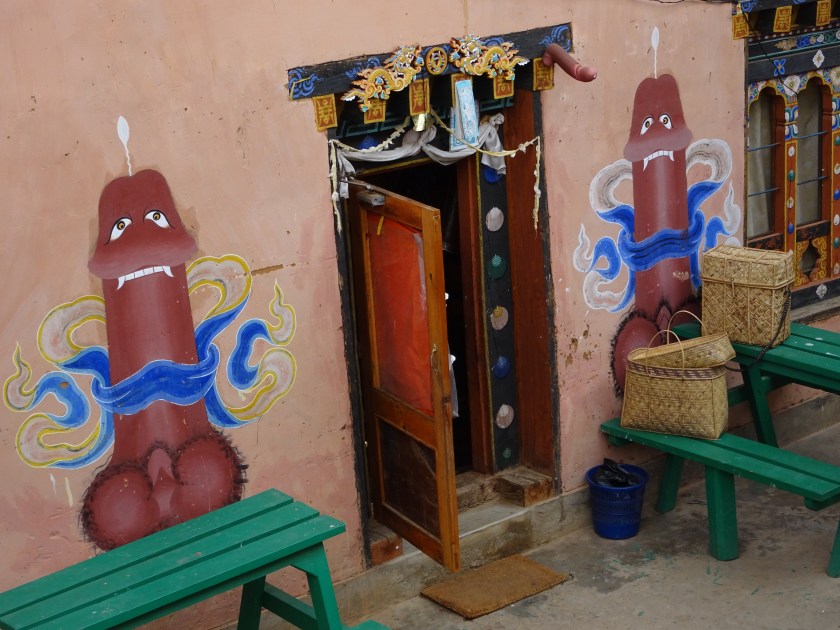
Even though lunch was a disappointment, we knew the next stop would pick us right back up.  As we approached the Chime Lhakhang Monastery, also known as the “Temple of Fertility”, it’s hard not to notice the phalluses everywhere you look. They’re painted on nearby houses, restaurants, hotels and like the monastery, they are there to honor one of Bhutan’s most revered saints, Drukpa Kunley.  Drukpa Kunley was not your typical BudDivine Bhutan. He was a womanizer and a liberal drinker. People call him the “Divine Madman” for his crazy antics and unique approach to Buddhism.  Buddha advocated the “middle way,” encouraging others not to pursue extremes. The Divine Madman believed these constraints were too restrictive. He discouraged the pursuit of Buddha’s teachings to common people. To gain attention and spread his message that these strict conventions were absurd, he took on a meditation practice indulging in song and dance, alcohol and women, hunting and feasting,  using outrageous behavior to show there was more to Buddhism than the middle way.  The phalluses that hang from the eves of Bhutanese homes are reminders of this unusual brand of Buddhism. As the legend goes, the Madman would subdue demons by clunking them on the head with his penis, or what he called a “flaming thunderbolt”, a symbol the Bhutanese have adopted to protect their homes from evil.  If you are wondering whether or not you read that paragraph correctly, you did.  Some of the mythological ideas that the Bhutanese believe in are so out of this world you almost want to laugh.  But that’s what makes this place so special.  They all believe, no matter how ridiculous it sounds to an outsider, and their traditions are what help them maintain the happiest country in the world status.

DSC06367

DSC06335

DSC06365

DSC06380

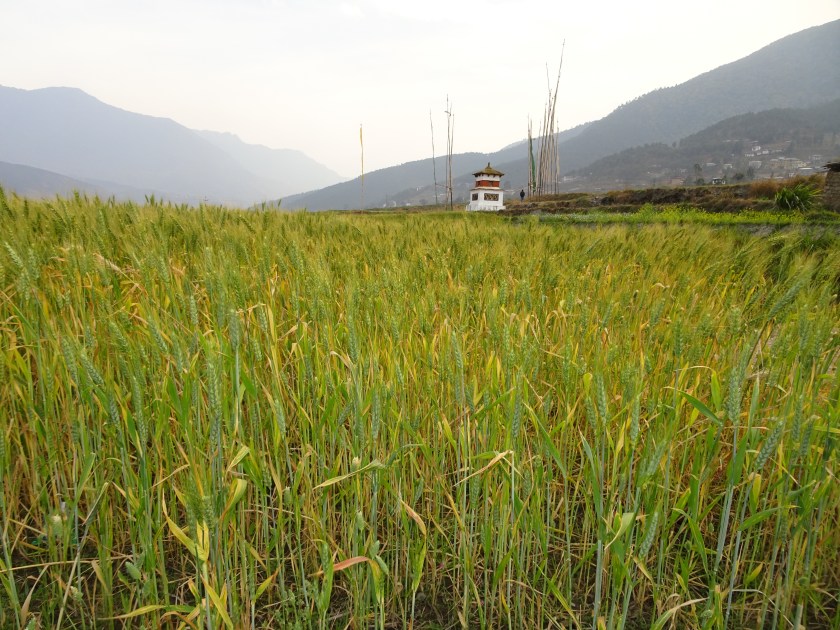
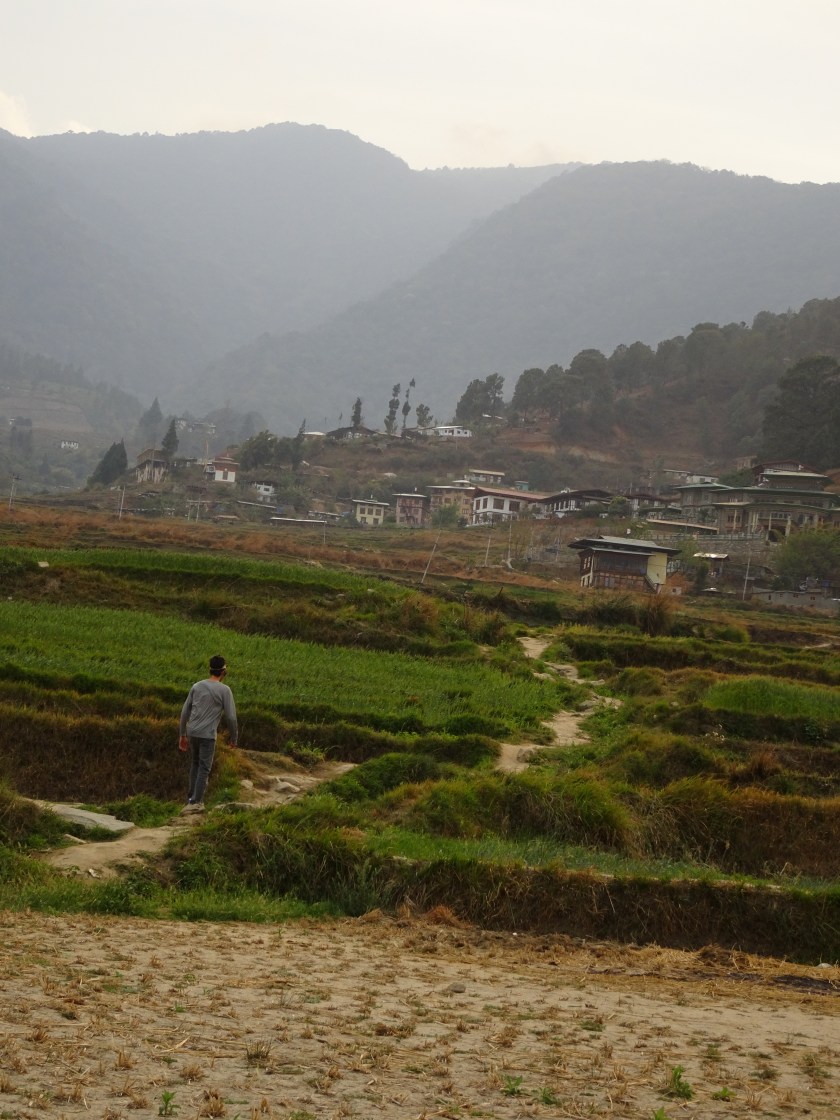
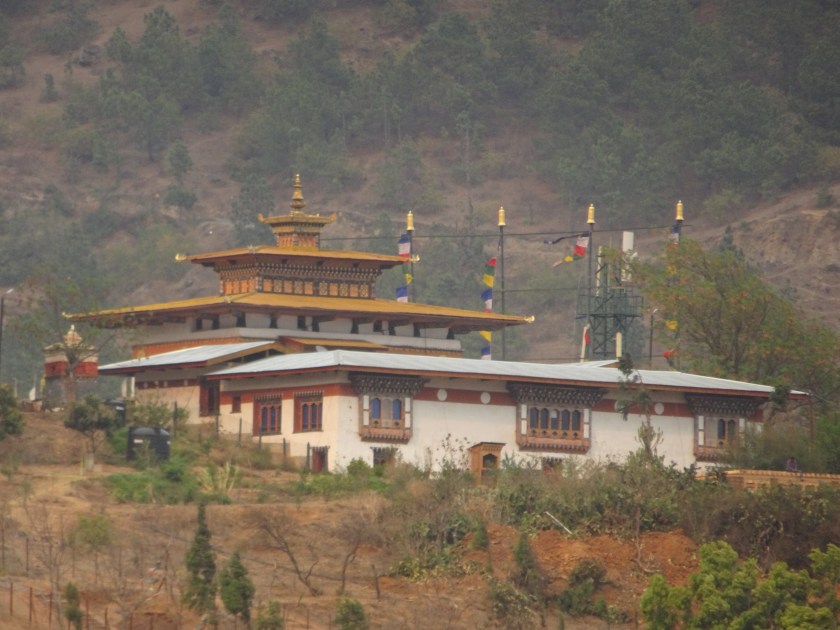
Once we became comfortable with penises all around us, we started our two hour excursion through a traditional village, up a narrow dirt path, through fields of rice, wheat and wild marijuana plants. In the distance, we can see the monastery.  Built in 1499, it sits on top of a hill that locals compare to a woman’s breast.  Yes, another amazingly entertaining concept.  According to the Bhutanese, Chime Lhakhang Monastery is a very sacred place.  It is widely known today that most of the people who visit the temple do so to pray for children – either to ask for children by those who are childless or to seek protection for children by those who already have them. There are many people in Bhutan, and indeed in other parts of the world, who will vouch on the success of their prayers.  Men and women having difficulties conceiving come to this temple, spend the night and historically, have given birth to a healthy child a year later.  Hence the name, Temple of Fertility.  Kezang welcomed Vinny and I back here should we face those same problems in the future.  Hopefully we won’t need the temple’s help but it would be interesting to see just how magical this monastery truly is.

DSC06336

DSC06338

DSC06342

DSC06345

DSC06357

DSC06377

DSC06375

DSC06374

DSC06363

Last on our road trip itinerary was the Sangchen Dorji Lhundrup Choeling Buddhist College for Nuns, inaugurated on April 25, 2015.  Bhutanese nuns are basically women monks but this institution was established to teach a new way of learning focused solely on nunnery and not resembling that of monks.   The college had great views of the valley, a few Nepalese style stupas and is home to over 170 nuns.

DSC06389

DSC06390

DSC06393

DSC06394

DSC06397

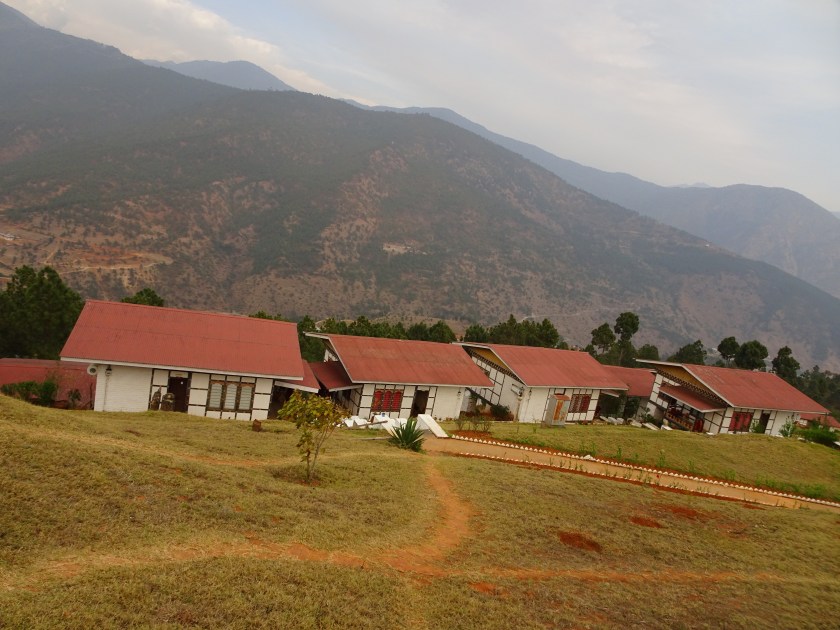
Around 6:30pm, after a very long yet fulfilling day, we checked into Punatsangchhu Cottages, our hotel for one night.  Tomorrow’s call time is 7am (ahhhhh) so we settled in, grabbed a quick bite to eat and then studied the back of our eyelids.

DSC06404

DSC06403

DSC06399

DSC06398

Our wonderful next day, March 18th, started with a two hour hike up to the Khamsum Yulley Namgyal Chorten, which sits on top of a hill, almost resembling a tiny gold pointed hat on a big round head.

DSC06406

First we had to cross an iron suspension bridge, decorated with colorful prayer flags, that brought you from one side of the river to the next.

DSC06409

Then we walked through rice fields and farm land that cultivates chiles, mango, wheat, guavas, eggplant, beans and much more.

DSC06417

DSC06421

DSC06423

DSC06425

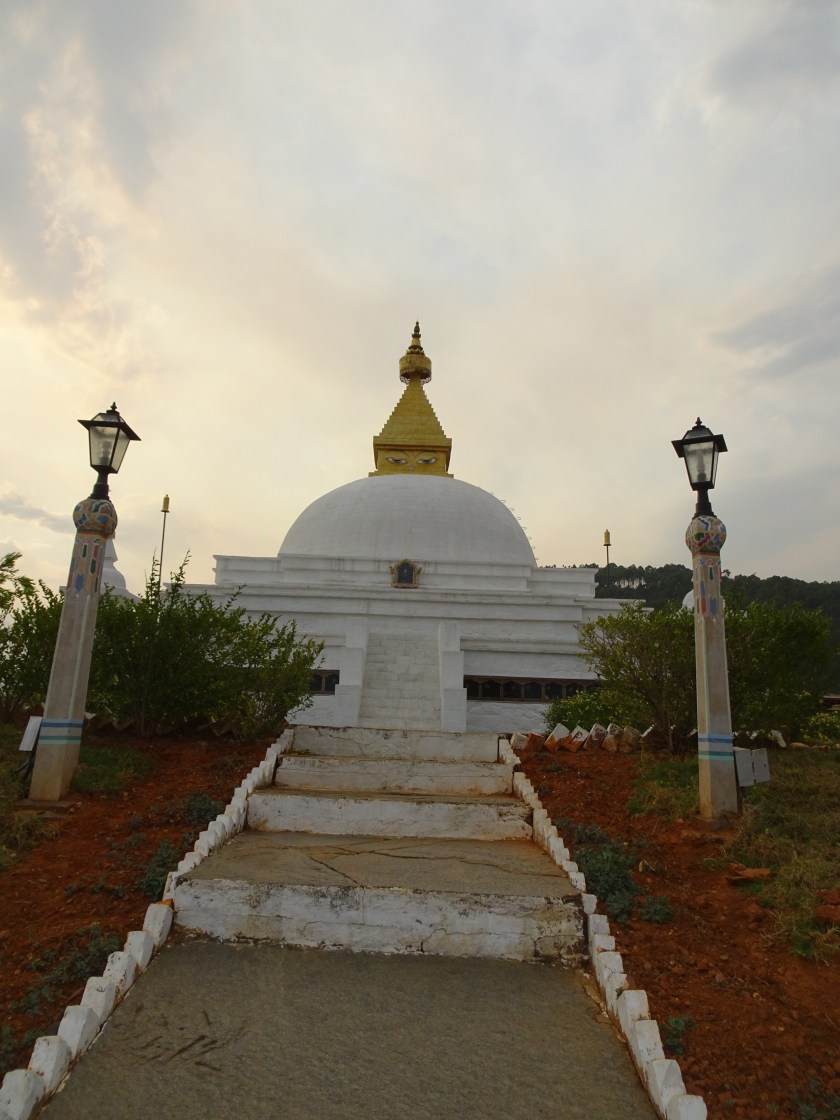
I guess we were a lot quicker than Kezang expected, probably because we live in LA and hiking is the thing to do so we were well prepared.  Go us.  At the top there’s a stupa, with 360 degree views of the entire countryside.  It took eight years to build and was consecrated during a three day ceremony in December 1999. The three-level chorten is topped by a dome and a stack of 12 circular rings, then an umbrella, the sun, moon and finally a jeweled pinnacle.

DSC06475

DSC06428

DSC06449

DSC06466

DSC06469

DSC06471

DSC06433

DSC06476

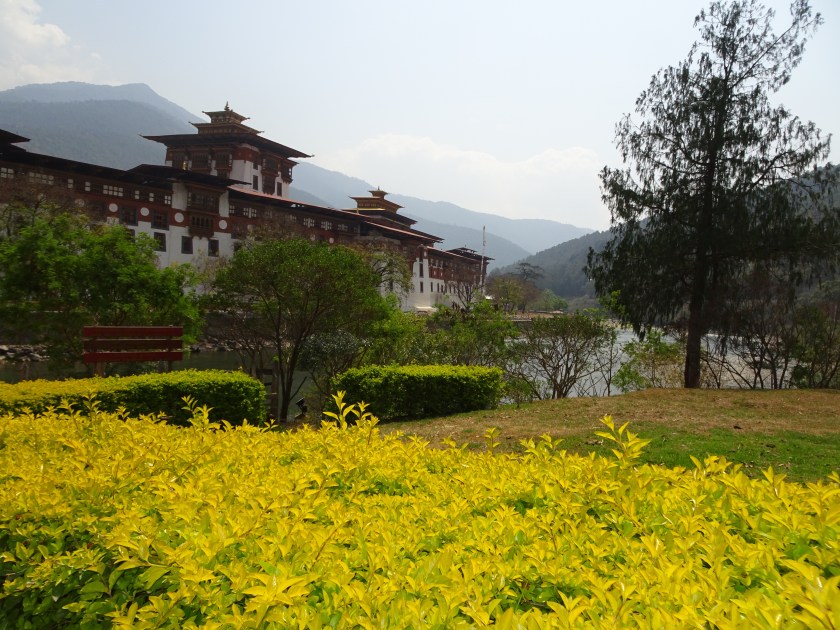
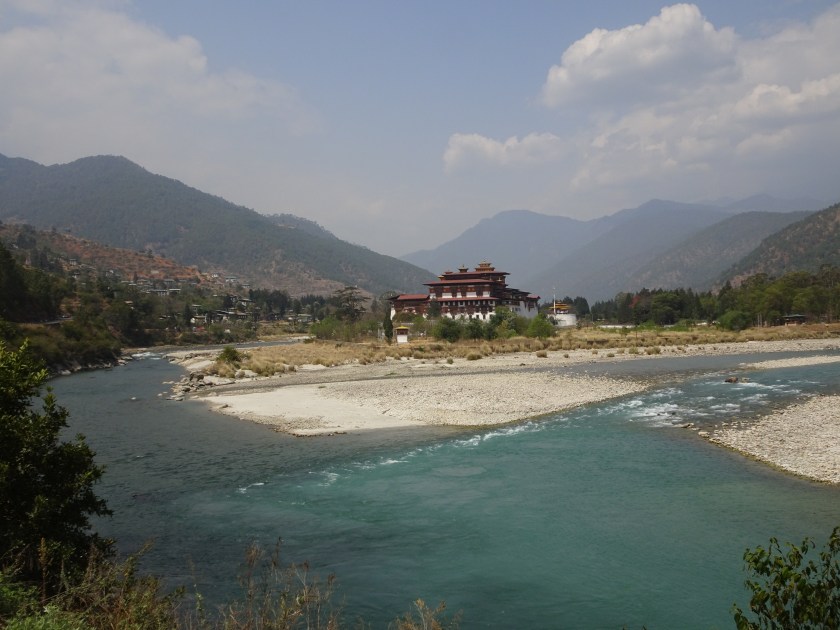
Punakha Dzong, otherwise known as the Fortress of Great Bliss, was our final stop in the Punakha area.  Punakha Dzong has been inextricably linked with momentous occasions in Bhutanese history.  It served as the capital of the country from 1637 to 1907 and the first national assembly was hosted here in 1953.  It is the second oldest and second largest dzong in Bhutan and one of the most majestic structures in the country.  On October 13, 2011, the wedding of the current King, Jigme Khesar Namgyel Wangchuck and his finance, Jetson Pema, was held here.  Currently, there are over 200 monks that call this home.  We are never allowed to take photos inside the various temples within the Dzong’s and although it’s understood why, it’s still such a bummer not to capture it.  Every temple has gigantic, extravagant, intricate, colorful statues of various Buddha’s and Deities.  I have never ever seen anything like it.  In my not-so-art world-educated-opinion, I personally feel that these monuments are the most beautiful, captivating, enlightening pieces of expression I’ve ever seen.  Absolutely stunning.  But you have no idea what I’m talking about so I’ll stop now.  I hope you enjoy the outside though.

DSC06484

DSC06489

DSC06520

DSC06526

DSC06527

DSC06532

DSC06540

Check out these natural beehives.  They almost look like a super sized oreo (and deep down inside, I was really hoping they were.  That sounds so good right about now).

DSC06492

To complete our day, we had lunch (which was much better than yesterday, phewww) and then drove back to Paro via Thimpu, which was a four hour journey.  Until we meet again in Paro, watch out for that odd shaped doorknob…

DSC06547

Thimphu, The Kingdom’s Capital

On Tuesday, March 15, we flew from Kathmandu, Nepal to Paro, Bhutan on Druk Air.  Bhutan Swallowtail, our tour group, recommended we arrive extra early to the airport in order to reserve window seats on the left hand side of the plane.  Very precise, right?  The reason for this is because we will be passing by the Himalayan Ranges and the views are supposedly breathtaking.  So we did just that.  We got to the airport at 6am and were able to pick the most perfect seats, which in turn, provided us with the most perfect views.   White capped mountain peaks pierced your eyes with beauty.  We flew right by eight of the ten highest mountains on EARTH.  No big deal.  I felt like they were going to eat us alive.  They were that powerful.  But the most exciting sight of all was Mount Everest.  Yes, Mount Everest.  Have you heard of it?  The highest peak in the center of this photo below is the infamous Mount Everest.  Why hello.  It’s such a pleasure to meet you.  Unlike Tom Cruise, this mission was possible.

DSC05876.jpg

When we landed at the Paro airport around 11am and walked off the plane, there was this sense of tranquillity that overtook my mind and body.  The sky was the brightest blue we’ve seen in a while, the sporadic chunks of clouds were marshmallow white, the mountain ranges were intimating yet welcoming and the air was so fresh you could feel your lungs going through an instant detox.  It was by the far the prettiest, calmest, cleanest, most simple airport I’ve ever stepped foot in. Their buildings resembled that of the traditional Buddhist architecture with colorful paintings, intricate designs and mesmerizing aesthetics. Something is telling me I’m going to really, really like it here.

DSC05887.jpg

DSC05884

DSC05885

After we went through customs, added yet another stamp to our passports and gathered our bags, we met up with Kezang, our twenty eight year old Bhutanese guide, and Tenzin, our twenty four year old Bhutanese driver.  Both of them will be with us for the next seven days – all day, every day (except for sleeping, duh).  Good thing we all seem to be easy going and fun or else that much time spent together is the perfect recipe for disaster.  When we got in the car and drove away, we almost had reverse culture shock.  Being in India and Nepal for the past nine weeks, we became so numb to insane traffic, intense pollution, crazy driving and endless honking.  But here, it’s the polar opposite (at least so far).  I don’t think they even know what the word traffic means.  While cruising down the “highway”, we were constantly noticing signs on the side of the road such as “Life is a journey, complete it”, “Speed thrills but kills”, and “Live for today, drive for tomorrow”.  Optimism at its best.  Glass is always half full.

Random side note(s).  Bhutan is fifteen minutes ahead of Nepal, thirty minutes ahead of India and now thirteen hours ahead of Los Angeles (would have been fourteen but daylight savings happened for the USA).  And, since Bhutan’s currency is pegged from the Indian Rupee, we can use our left over money here.  Yippee.  Our itinerary is as follows: we will be spending two nights in Thimphu, one night in Punakha and three nights in Paro.

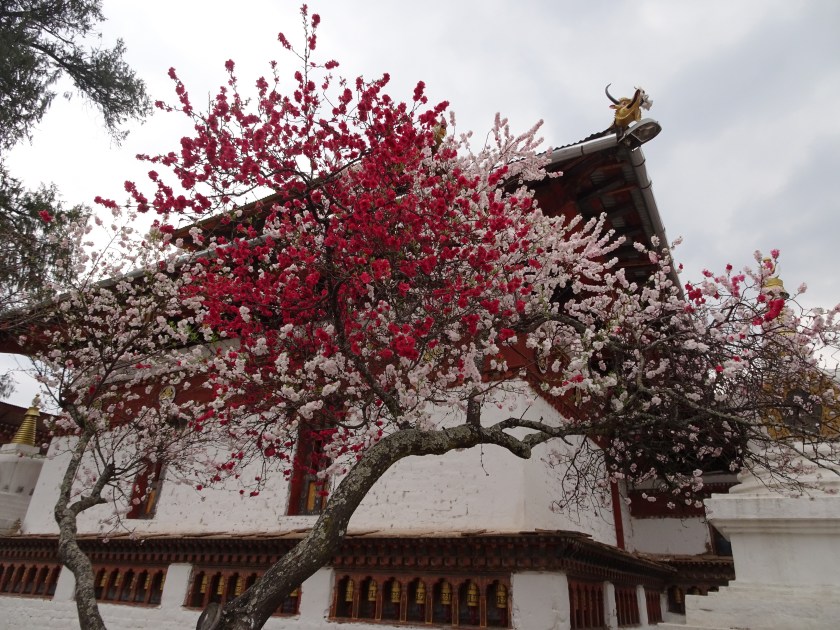
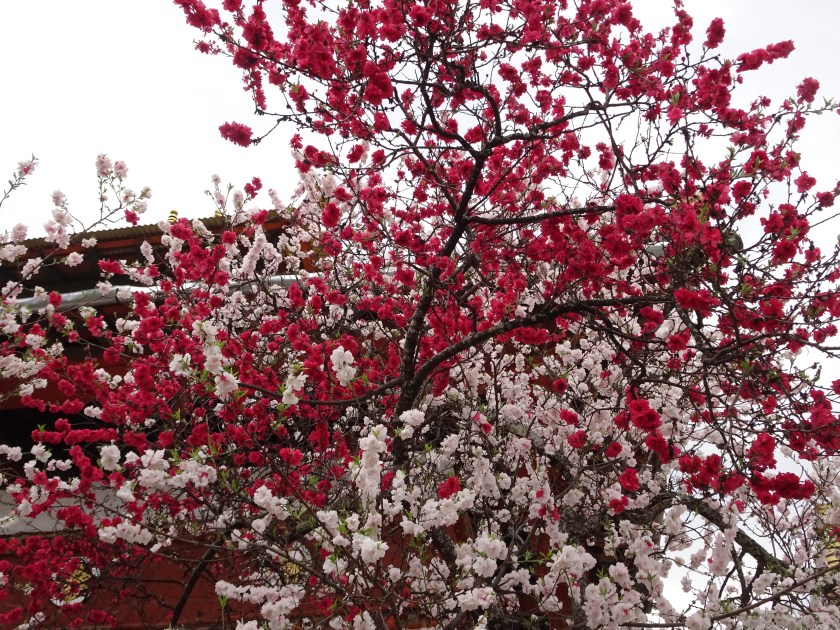
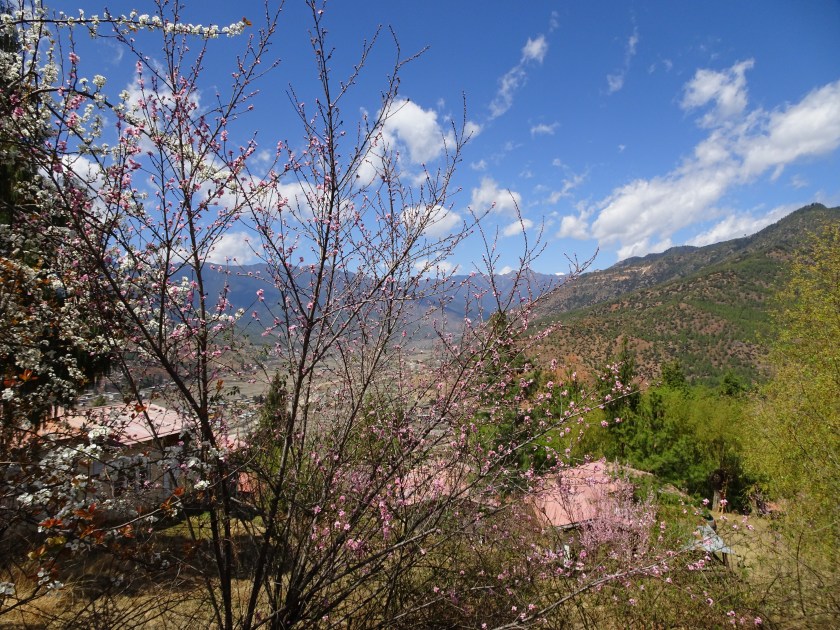
Okay, back to my story.  The drive from Paro to Thimpu is about one hour.  Since we didn’t fly across the world to get here like most people do and we weren’t overwhelmed with jet lag, Kezang wanted to take us to a few sites in Paro now versus when we come back at the end of our trip.  The thought process behind this is because the annual Paro Tshechu Festival will be taking place starting March 19, which is partly why we chose these dates, so most of the area will be congested with people from all over the country.  That being said,  our first stop was the National Museum of Bhutan, which opened to the public in 1968.  However, the cylindrical or conch shaped building was originally constructed in 1649 C.E. and served as a watchtower to protect the Paro Rinpung Dzong below from invasions in all directions.  Here we learned some key facts about their culture, their beliefs and their history. A visit through the galleries showed the country’s transition from the Stone Age to a modern Mahayanist Buddhist and multicultural kingdom.  Definitely informative and a perfect way to introduce us to the very unknown Bhutan.  While we were walking up the steps towards the entrance, I couldn’t help but notice some pretty flowers bursting like a pink Starburst so cheerfully from the trees.  They resembled that of the cherry blossoms in Japan.  When I asked Kezang what type of flower they were, he confirmed they were in fact cherry blossoms.  Oh my god (maybe I should say oh my Buddha here instead).  This is the best surprise party anyone could give me.  I’ve always wanted to see cherry blossoms well blossom.  Absolutely incredible.  What a lovely site.

DSC05898

DSC05892

DSC05889

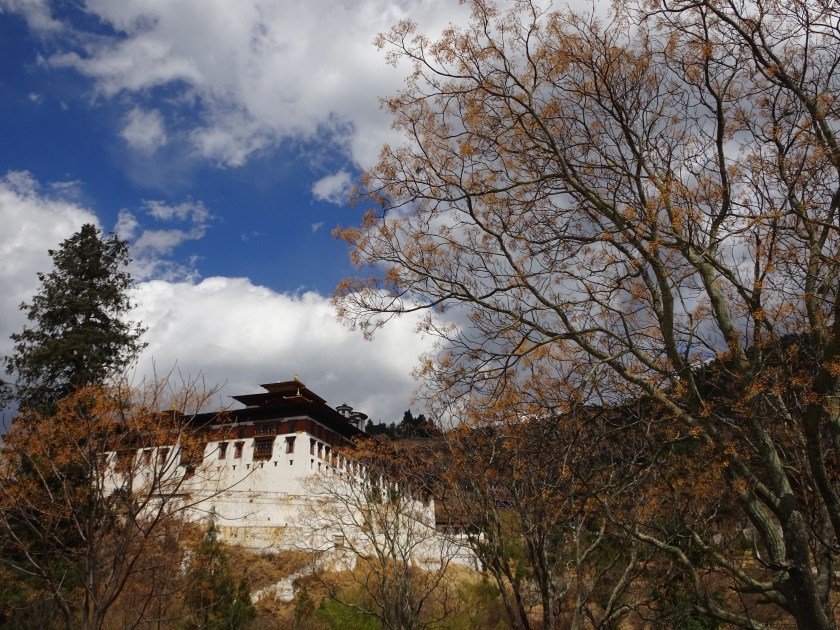
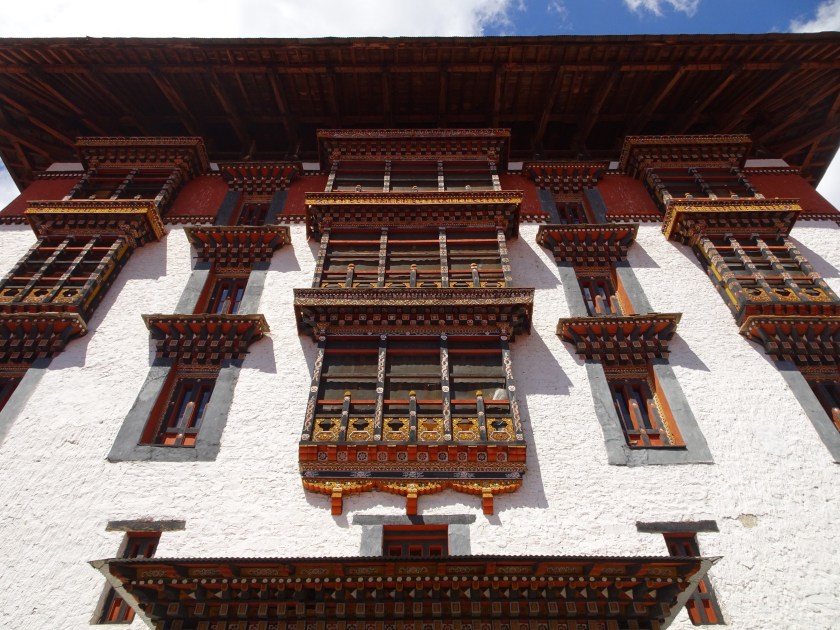
Our second stop in Paro before heading to Thimphu was the Paro Rinpung Dzong, which means “Fortress of the Heaped Jewels”.   Built in 1644, the Paro Dzong is one of Bhutan’s most impressive and well-known dzongs (fortress), and perhaps the finest example of Bhutanese architecture in the country. The massive buttressed walls that tower over the town are visible throughout the valley.  The fort was used on numerous occasions to defend the Paro valley from invasions by Tibet.  Today, it houses about two hundred monks and when I saw a handful of young monks walking around, I became curious about the process.  Who can become a monk?  Are you forced or is it voluntary?  Is there a minimum age?  Kezang basically explained to us that there used to be a “monk tax” where families had to give one of their sons to the monastery.  However, now that there are so many, it is more of a personal decision.  Some start as young as two years old.  Kids don’t even know their name or their favorite color at two years old let alone knowing they want to dedicate to their entire life to Buddhism.  Such a different upbringing than what we are used to.  On the opposite spectrum, some start as old as sixty.  That’s the cool thing about Buddhism.  There is no judgement and no discrimination.  Come one, come all.

DSC05931

DSC05929

DSC05924

DSC05903

DSC05905

DSC05923

DSC05911

DSC05915

It was around 1pm so we headed to lunch, which consisted of traditional Bhutanese food such as butter tea, chiles and cheese, red rice, steamed vegetables and egg noodles.  I didn’t love the butter tea (tasted almost like sipping on a melted stick of butter) but the chiles and cheese had me at hello.  Absolutely delicious.  For a lack of a better comparison, the cheese resembled that of fake nacho cheese you get at the movies or a sporting event but instead of chips, it was slices of chiles that were so spicy.  My lips were tingling dramatically out of control as if I used a pound of ghost peppers as chapstick.  One of those hurts so good feelings.

DSC05934

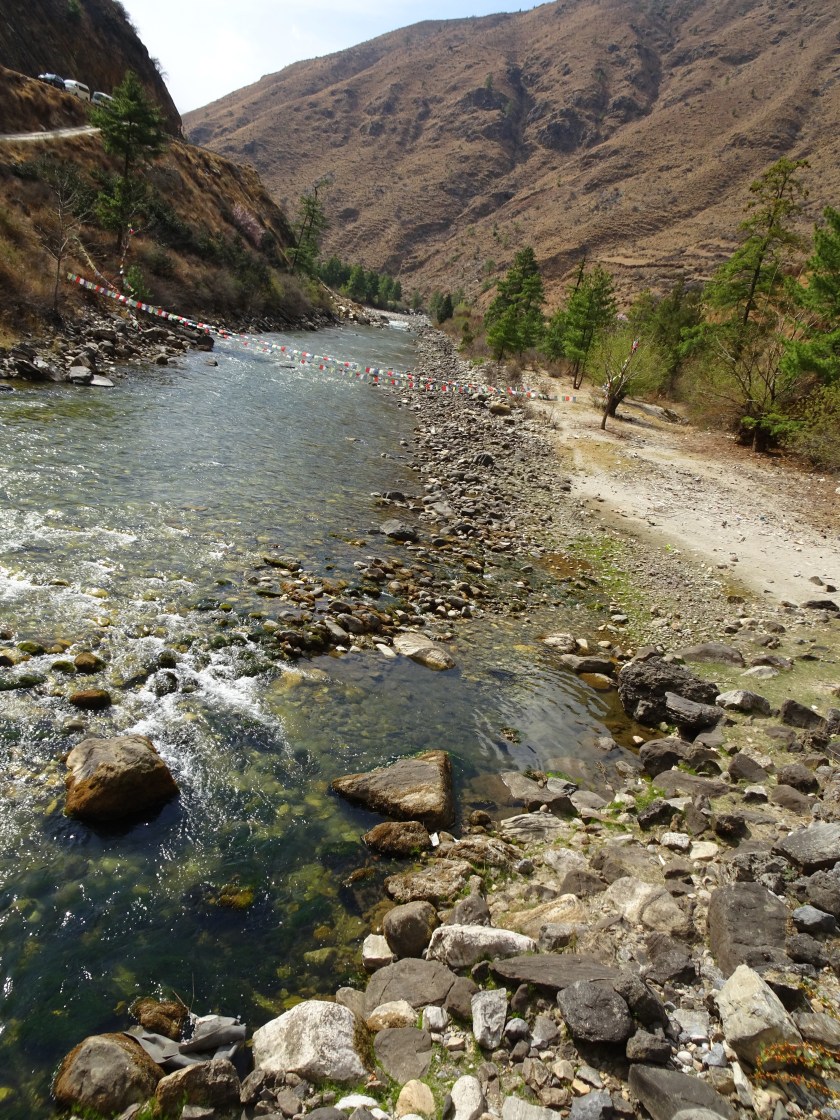
Now that we refueled our bodies, we continued along the way to Thimphu.  The next stop was Tachogang Lhakhang, which is an iron suspension bridge made out of chains.  It was built in the early 15th century by Yogi Thangtong Gyalpo.  While slowly and carefully walking across the bridge, you couldn’t help but notice the clearer than clear eyes water flowing below.

DSC05938

DSC05950

DSC05953

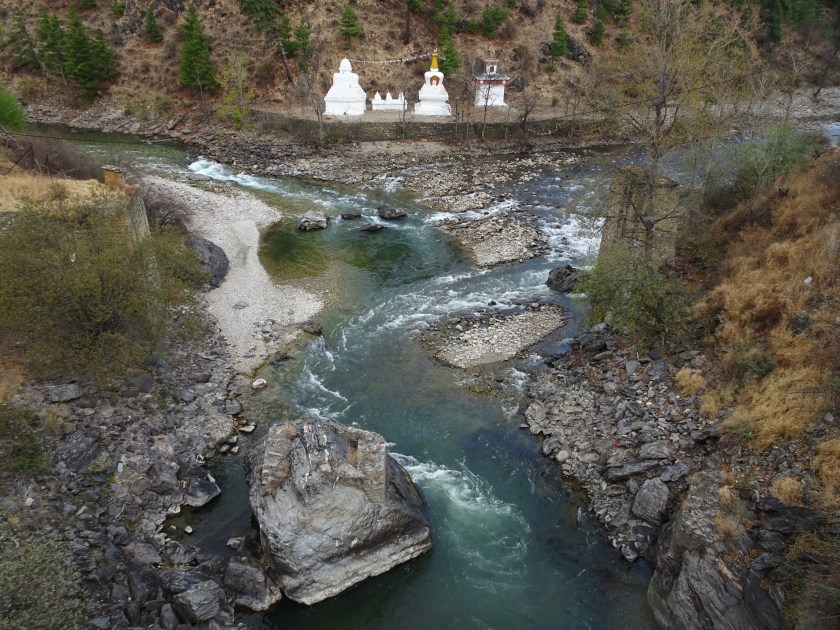
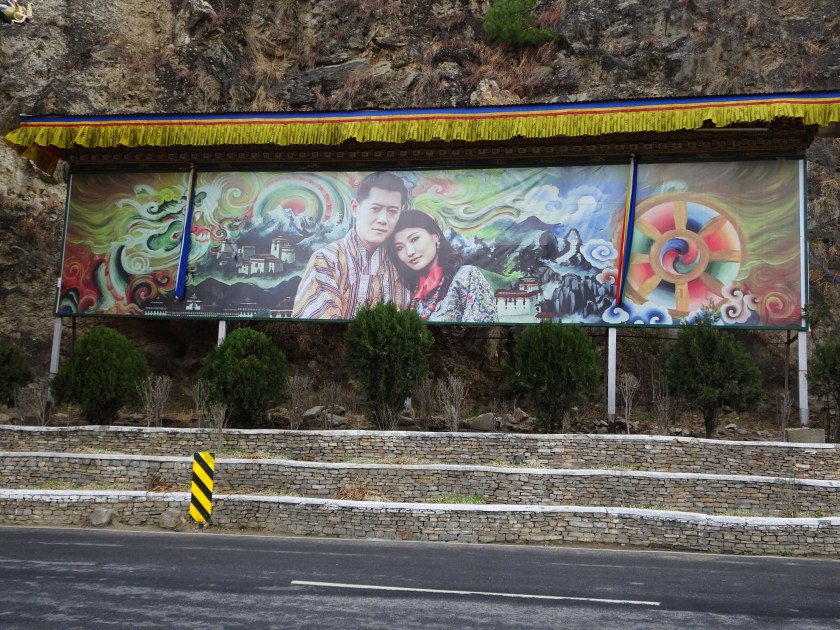
Then we came across a fork in the river, where the Paro and Thimphu Rivers meet which flows down to India. At the crossroads, there were three different stupa styles.  One was from Nepal, one was from Tibet and one was from Bhutan.  Oh and there was a massive billboard that had a photo of the King and Queen.  Seems to be typical.

DSC05962

DSC05963

DSC05966

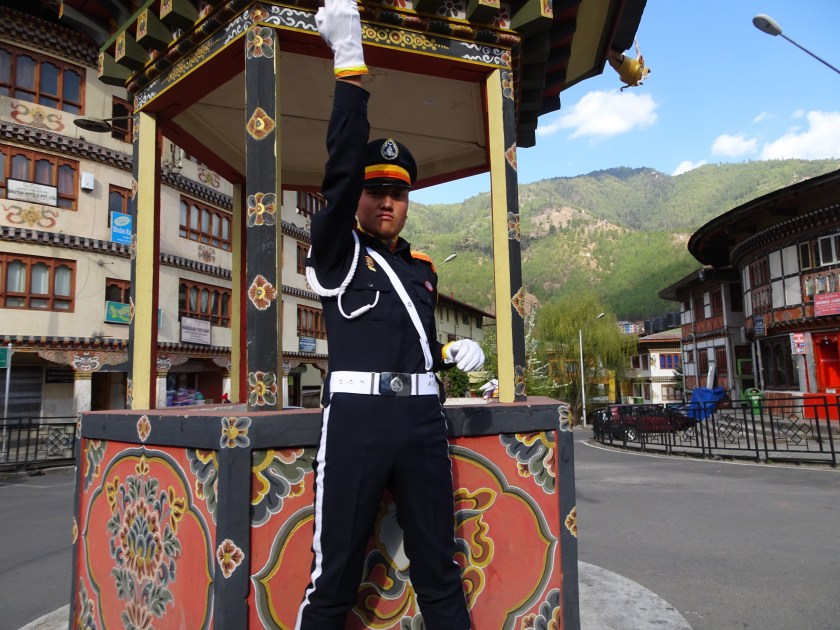
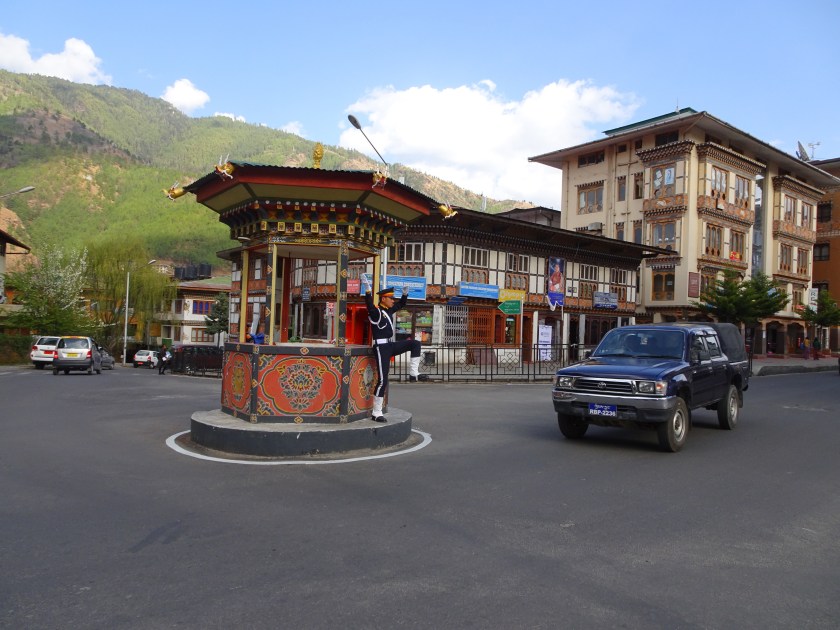
When we finally arrived in Thimphu, we got out of the car and strolled down what they refer to as Main Street.  It totally reminded me of the Main Street at Disneyland.  Very clean, quiet, happy, and nearly perfect.  Almost fake looking.  Thimphu is one of the only capital cities in the world, if not the only, where there are no traffic lights so the few cars that do pass by are orchestrated by a man in a legit uniform with white gloves stationed outside a festive booth.  And everyone actually follows directions of when it’s their turn to go and their turn to stop.  Well trained individuals.

DSC05969

DSC05973

DSC05976

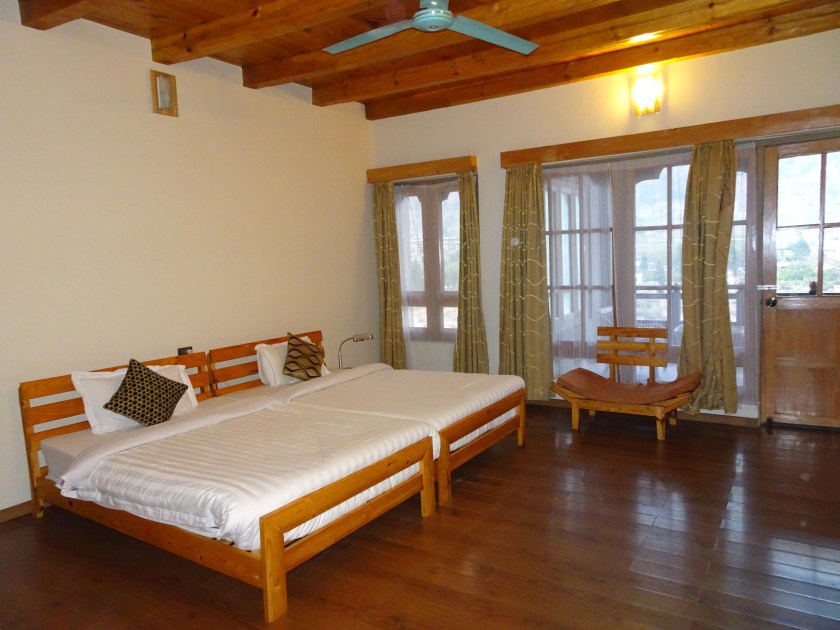
Around 4:30pm, we arrived at Peaceful Resort, our hotel for the next two nights.  It was a ten minute drive from town, located higher in the hills than in the city center.  Since Bhutan Swallowtail booked all of our accommodations for us, we had no idea what to expect.  And because I’m such a control freak (admitting it is the first step to recovery), this was really hard to accept.  Nevertheless, the Peaceful Resort was definitely a decent place so I felt a little more comfortable now.  Our room was made of all wood, giving off that wintery cabin vibe.  For the remainder of the evening, we laid low, had dinner and got a good night’s sleep since tomorrow will be yet another full day of sightseeing, learning and of course, smiling.

DSC05990

DSC05991

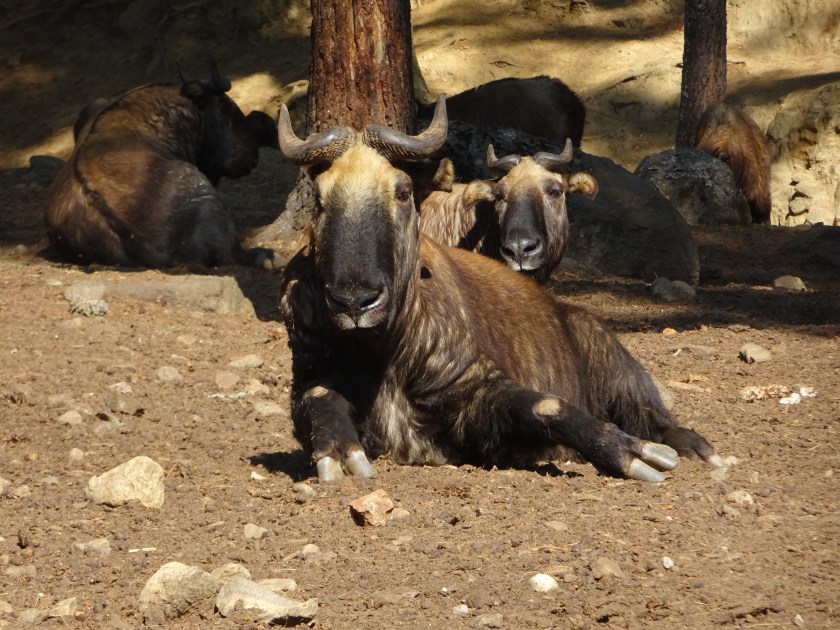
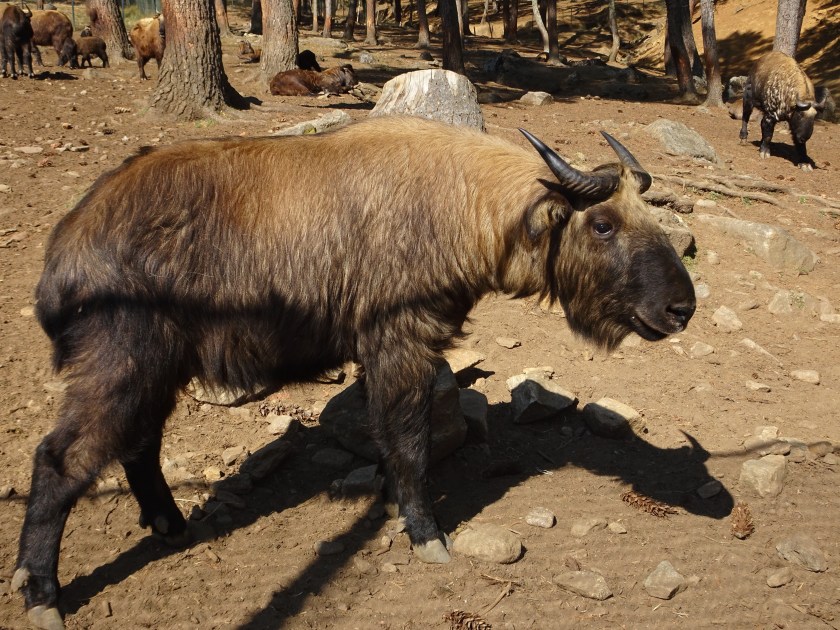
Wednesday, March 16, started off with a visit to the Takins, which were declared Bhutan’s National Animal on November 25, 1985.  A Takin is one of the larger and stockier goat antelopes, generally weighing around 770 pounds. It is a very unique looking animal that is believed to have the head of a goat and the body of a cow.  They are usually found in the Himalayas and western China.   Just like everything in Bhutan, there is a mythological story behind the creation of this animal but since it does sound rather crazy, I will spare you the details.

DSC05992

DSC05995

DSC06007

DSC06018

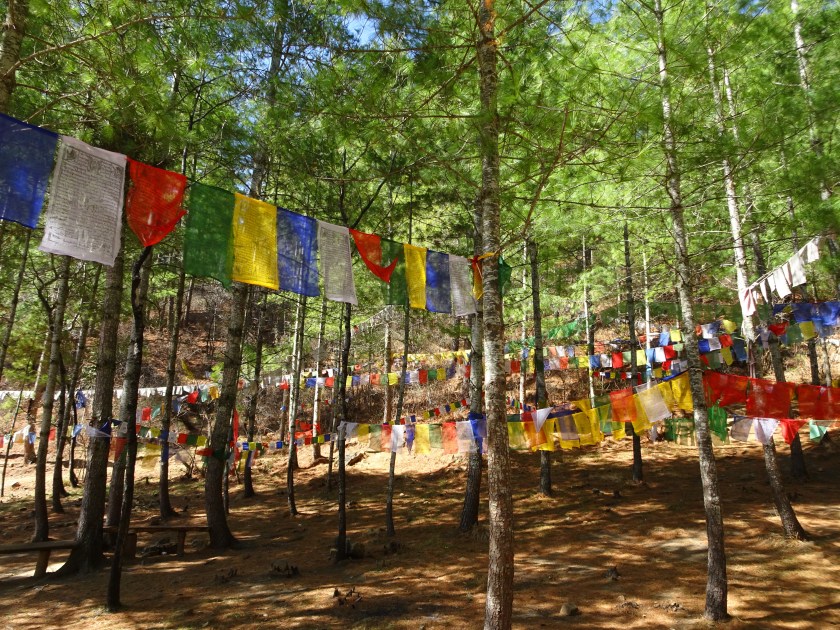
Next, we went for a short hike through a park high above the city of Thimphu.  Everyday for the next four days we will slowly prepare ourselves for the Tiger’s Nest, which is an intense climb up a steep mountain over 10,000 feet above sea level.  With the drastic change in altitude here, Kezang wants us to get acclimated before he throws us to the wolves.  And I thanked him kindly for that.  Throughout this walk, there were an abundance of prayer flags hanging from every tree possible.  They add so much life and color to the atmosphere and obviously have such a strong spiritual meaning behind them as well.  Not to mention, the views were spectacular.  Everywhere you looked there were mountains and mountains and mountains and trees and trees and trees.  I just love how underdeveloped this country is.  More land doesn’t equal to more buildings, at least for now.  And, people get fined for littering which is how it should be.  There was so much trash all over India and Nepal that to see a clean environment is refreshing on so many levels.

DSC06021

DSC06022

DSC06024

DSC06029

DSC06038

DSC06039

IMG_1237

DSC06047

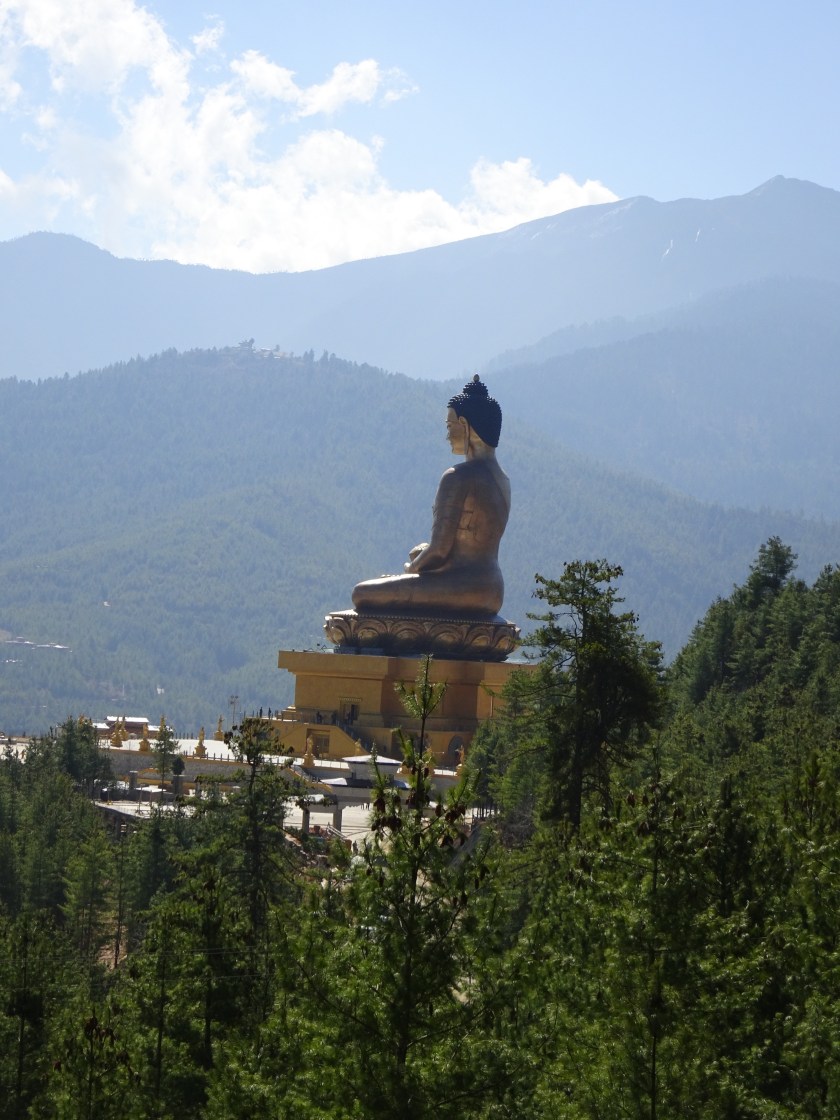
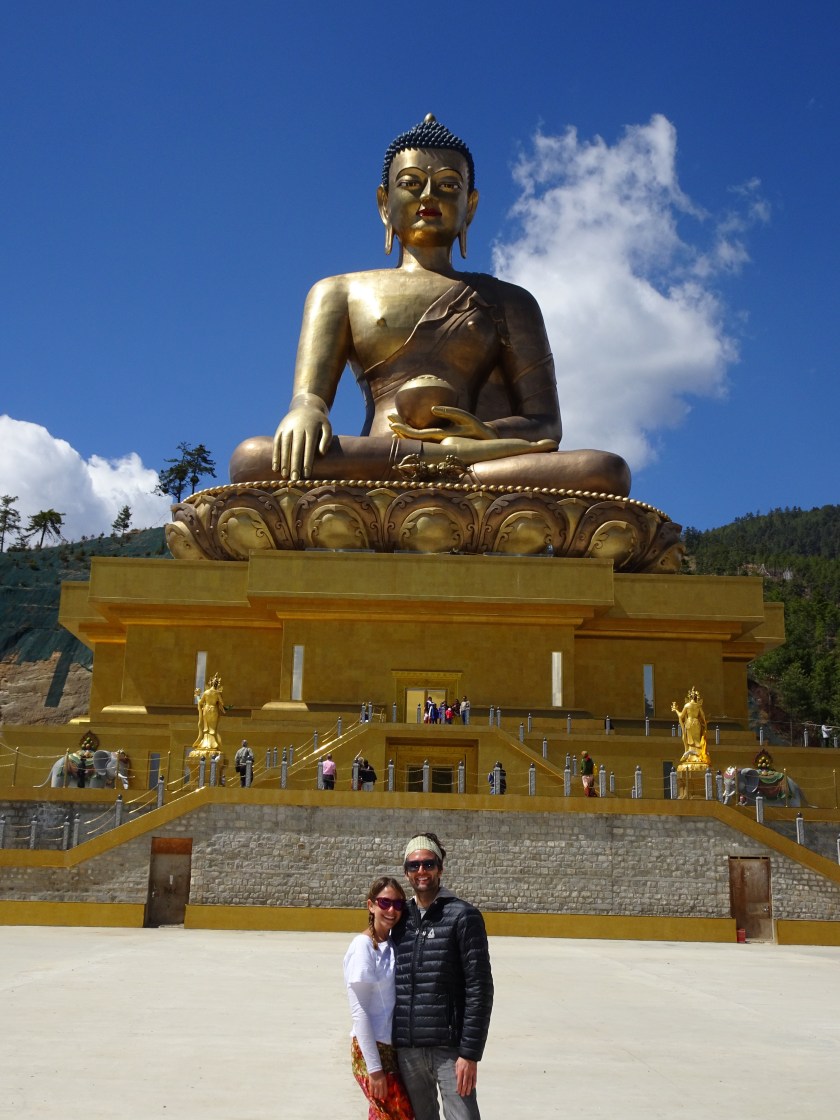
The end of our hike was rewarded with the Buddha Dordenma, which is a gigantic 169 foot tall statue, making it one of the biggest of Lord Buddha’s in the world.  Made of bronze and gilded in gold, it symbolizes indestructibility in addition to peerless virility to bestow blessings, peace, and happiness on the world.  Completed in 2015, the goal is for this monument to become a major pilgrimage center for Buddhists all over the world to practice, meditate and retreat. It was ridiculously stunning.  Your mouth instantly dropped to the ground in awe.  The detail was impressive from the nail buds to the chest to the face.  Beautifully created.  Inside there was a Buddhist temple that consisted of 100,000 eight inch Buddha statues.  Unfortunately, we couldn’t take photos of the inside.  Sorry.  You’ll just have to go there and see it for yourself.  I promise it will be worth it.

DSC06025

DSC06053

IMG_1257

DSC06076

DSC06080

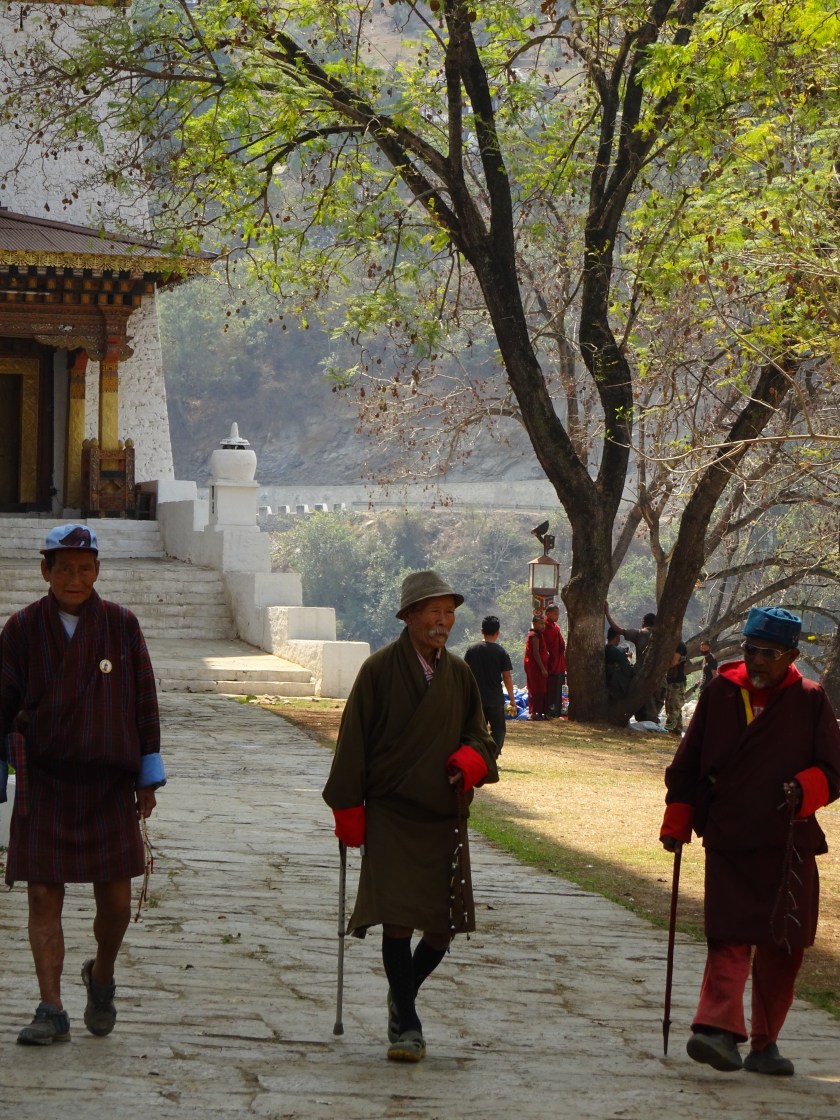
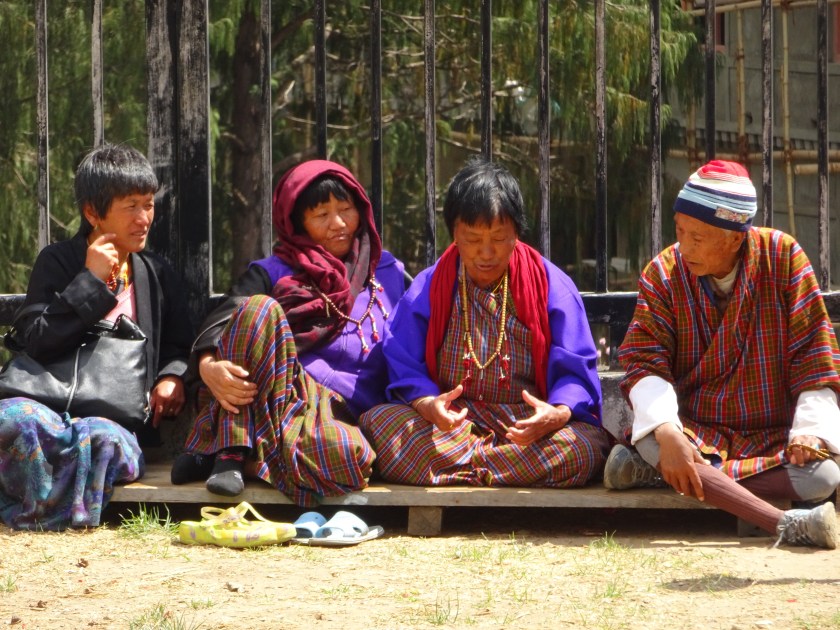
Next up was the National Memorial Chosen Stupa, which was built in 1974 by the Queen in memory of her royal son, the third King who died in 1972 at the age of 44.  Locals come here at all hours of the day for their daily worship.  They always walk around the stupa clockwise three times.  It was packed with quite a few elderly folks, almost as it if it was an outdoor assisted living center.  Made for intriguing people watching.  And there was the most adorable little boy who was so proud to show off his traditional Bhutanese attire.

DSC06100

DSC06105

DSC06112

DSC06114

DSC06121

DSC06123

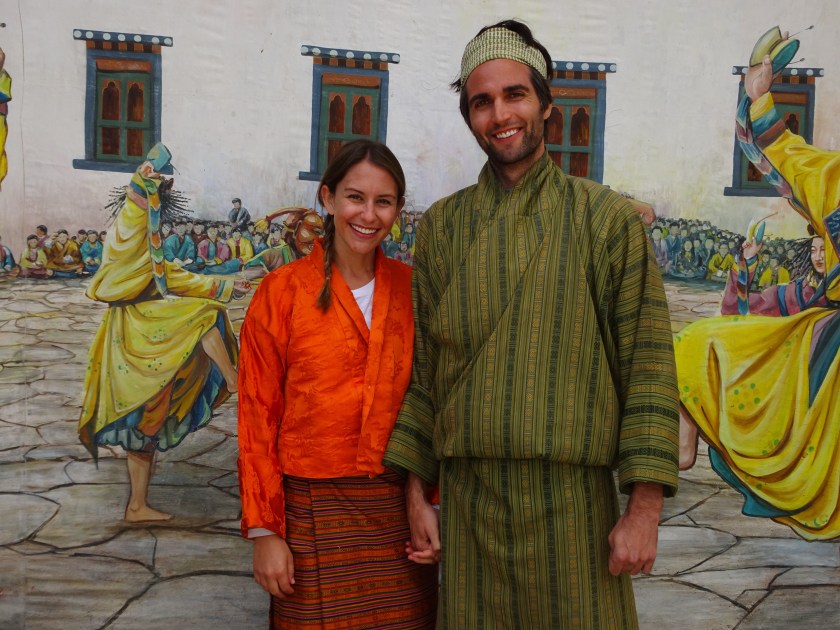
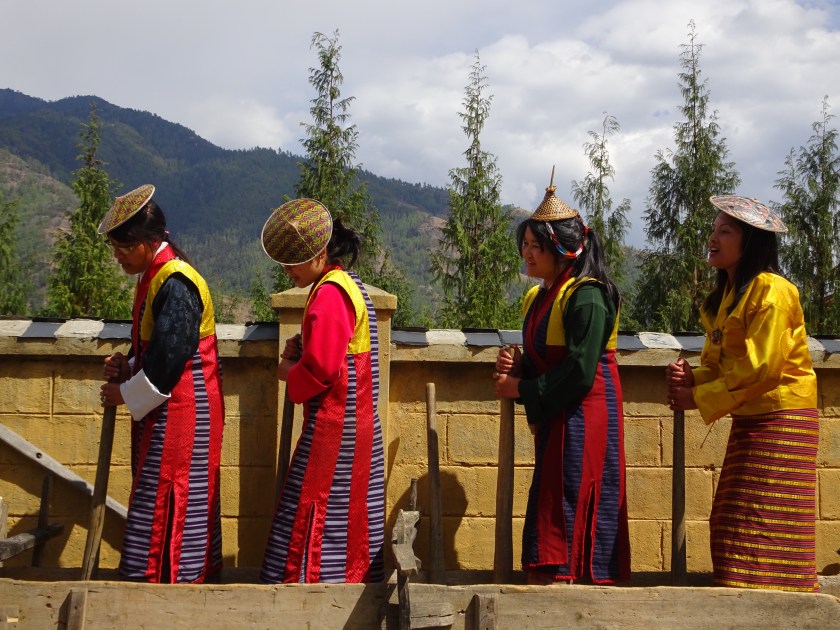
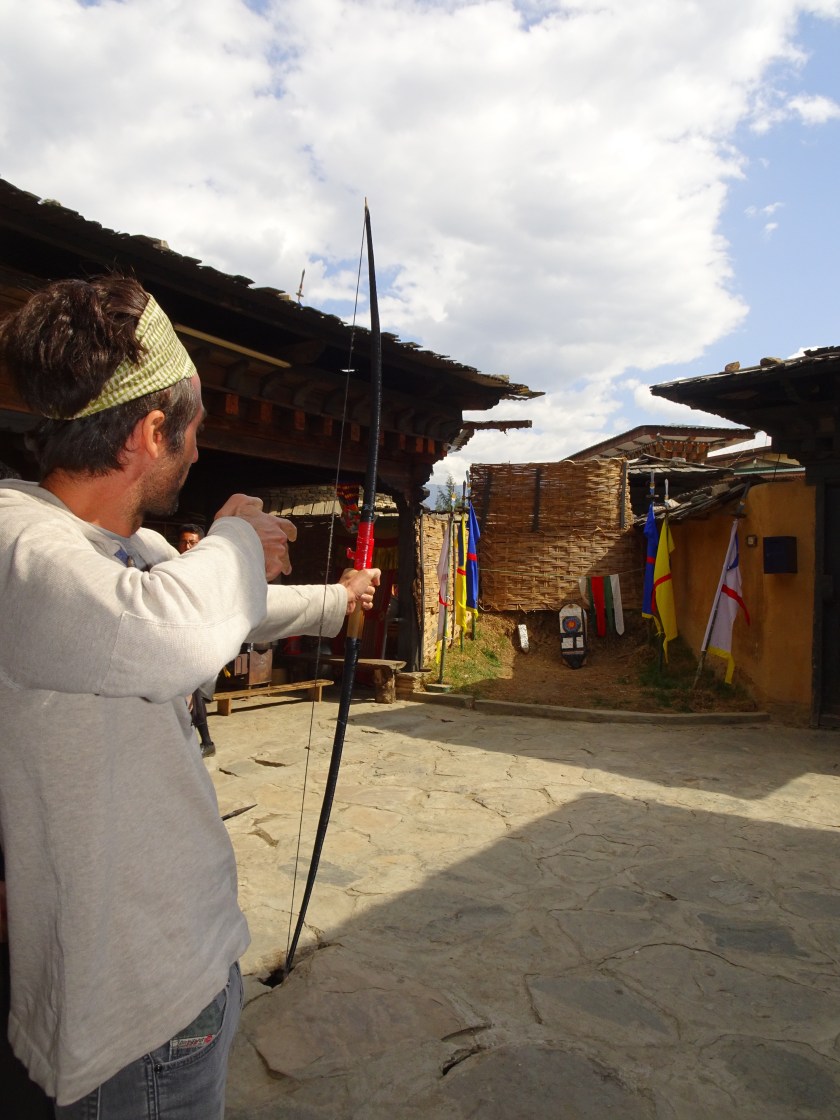
Simply Bhutan, a living museum and photo studio, is aimed at the preservation and promotion of the Bhutanese culture.  Vinny and I had the privilege to dress up in local clothing, see a traditional song and dance be performed, enjoy some authentic food, learn more about their fascination with the phallus, play some archery since it is their national sport (Vinny almost hit the bullseye!) and the most inspiring of all, meet Pema Tshering, a talented 30 year old craftsman, who was born with cerebral palsy and congenital deformities in his spinal column.  With limited mobility, Pema is only able to use his feet to carry out his daily routines. He now supports himself through the sales of his woodwork at the museum gift shop.  Pema’s unwavering belief in himself and his sheer optimism continues to inspire many people living with disabilities. His story tells us that with self-determination, anything is possible.

DSC06131

DSC06138

DSC06144

DSC06146

DSC06150

DSC06152

Bhutan has a very unique interest in postal stamps so we visited the Postal Museum to learn more about this borderline obsession.  While bare-footed couriers still deliver the mail in many remote regions of this Himalayan kingdom, Bhutan’s postage stamps remain world-renowned in the philatelic community. Colorful, creative and collectible, Bhutan’s stamp launch in the 1960s of the world’s most innovative stamps not only caused a sensation each time they were released, but more importantly were valued by Bhutan as its chief revenue producer for many years.  Prior to the 1960s, Bhutan had remained closed to the outside world. Then in 1962, Bhutan released its first international postal stamps and began its postal program. This came about through the partnership and innovation with an old friend to Bhutan, an energetic and pioneering entrepreneur, Burt Todd, who was also the first American to enter Bhutan. Postage stamps became the vehicle through which Bhutan could begin to open its doors and be internationally recognized as a sovereign nation amidst two huge superpowers – China to the north and India to the south.  The most infamous of them all were the Bhutan record stamps. These stamps played the Royal Bhutan Anthem, folk-songs and a short history of Bhutan.  Pretty serious, huh?  Vinny and I had our own stamps made and mailed postcards back home to our families.  When in Bhutan, I guess…

DSC06159

DSC06157

After we put our faces on stamps, we visited The Authentic Bhutanese Crafts Bazaar situated in the centre of Thimphu town.  It is a mile-long row of shops made of bamboo and other eco-friendly material. There are about eighty four stalls in total and almost all shopkeepers are women with the men folk helping them with the more strenuous duties. The beauty of the products lies in their original craftsmanship and in their indigenousness. The shops were allotted to these womenfolk on the condition that they would only sell products which were produced in Bhutan and not import products from other countries.  The ladies are helpful, courteous and very obliging while you browse through their wares. A very pleasant experience for those just window shopping.


DSC06160

DSC06167

DSC06163

DSC06166

Even their library was incredibly beautiful from the outside, exemplifying the traditional Buddhist architecture like the rest of the city.  As we slowly walked up and down the aisles of books and books and books, you can’t help but notice that about 95% of them are on Buddhism with the other 5% sharing the social sciences and history categories.  The library is also home to the world’s largest published book (certified by Guinness World Records) about one of the world’s smallest countries.  This book, titled Bhutan, is over five by seven feet, includes 114 pages and weighs about 133 pounds. It is a visual odyssey across the kingdom that took over 40,000 photographs throughout four extensive expeditions by helicopter, mountain ponies, trekking with packhorses and yaks, and journeys by caravan on far-flung roads.  Only 500 copies were printed and in order to obtain this book, you had to make a $15,000 donation where proceeds fund Bhutanese schools.

DSC06177

DSC06189

DSC06175

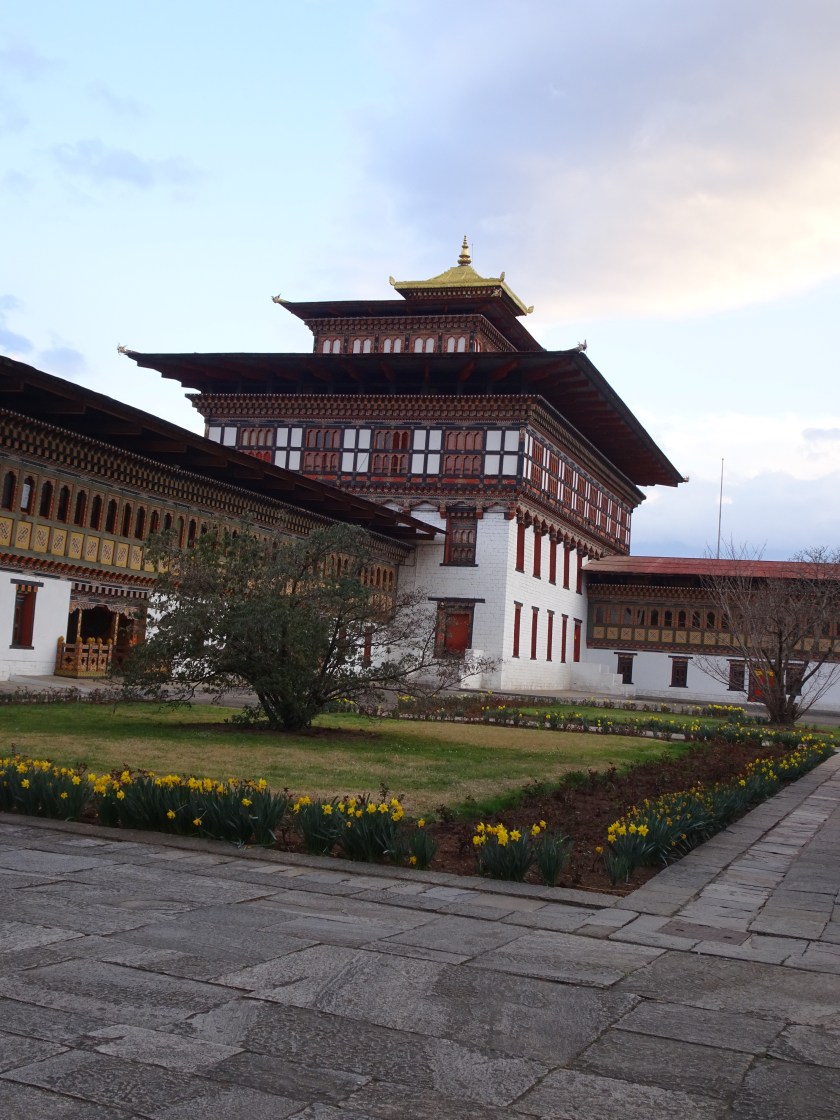
Last on our Thimphu tour, was Tashichho Dzong  or the “Fortress of Splendid Religion”.  It was first constructed in 1216 A.D but after a fire in 1771 and an earthquake in 1897, it was rebuilt in 1902.  Then, when the capital of Bhutan was moved to Thimphu in 1961, it was renovated and enlarged using neither nails nor written plans.  Tashichho Dzong has been the seat of the government since 1962 and presently houses the throne room and offices of the king, the secretariat and the ministries of home affairs and finance. Other government departments are housed in buildings nearby.  We couldn’t enter until after 5:30pm because all of the government officials were still conducting business.  At night, it lit up with red lights and it was oh so beautiful.

DSC06200

DSC06212

DSC06223

DSC06222

DSC06213

DSC06225

DSC06232

DSC06241

The next morning we checked out of the Peaceful Hotel around 8:30am and headed to the Punakha Valley, which is about a three hour drive.  See you there!


Bhutan, A Land of Happiness

Before I go into great detail about what we did each day while in Bhutan, I wanted to provide you with some background on this fascinating country since most people have never even heard of it.  In my bias opinion, there truly is nowhere else in the world like Bhutan.  Not because of their landscape or their food or their people or their history but solely because of their values.  Marketing campaigns read “Happiness is a Place”, ”Almost Heaven” and ”Where Happiness Matters the Most”.  After spending seven days here, I can honestly say these slogans aren’t just a way to lure foreigners to visit.  The Bhutanese practice what they preach and what they preach, we should all start to practice.

In the age when not even a secretive communist state is spared from the Internet, Bhutan remains one of the most mysterious lands in the world.  However, since allowing their first tourist to enter in 1974, it is slowly opening itself up, one smile at a time.  Unlike other countries who have lost their culture and traditions to mass tourism, Bhutan is doing everything in their power to preserve what they are so proud of while still providing a glimpse into what their everyday lives entail.  One has to experience Bhutan first-hand in order to fully understand how they have managed to turn a fairytale dream into a living reality.  In the end, what’s the point of having pockets full of money, houses full of stuff and garages full of cars if you are not happy?  And happiness is all that matters in this magical place known as Bhutan.

Here are some educational facts for you to understand just how special and unique this place is:

  • Bhutan is reputed for pioneering a concept, known as Gross National Happiness, that places people (and not material wealth) at the center of its developmental values.
  • Only 750,000 people have the privilege to call Bhutan home.
  • Surrounded by the Himalayas and sandwiched between China and India, Bhutan is a landlocked country.
  • Bhutan’s Royal Family is a bit different than other Royal Families.  Princes don’t need to wait for their fathers to pass on to become King.  Princes become Kings whenever their fathers feel like handing over the throne.
  • Bhutan is currently on their fifth King, who is about thirty six and is married to a woman who is only twenty six.  They just gave birth to a baby son, Bhutan’s new prince, in February 2016.
  • The fourth King married four sisters and had ten children in total.
  • The third King became King at the age of seventeen when his father, the second King, suddenly died of a heart attack while on business in India at the age of forty four.
  • The Kings are worshipped as if they are Gods.  Photos of them are in every house, at every restaurant, in every hotel, on roadside billboards and so forth.
  • Thimphu (population 100,000) is the economic, religious and government center of the country, residence of the Royal family and one of the only capital cities in the world with no traffic lights.
  • The entire country is served by only one international airport, which is located in the city of Paro.
  • There only two airlines that fly to Bhutan, which are Druk Air and Royal Bhutan.
  • Only eight pilots in the world are certified to fly into Bhutan, as the runway is small and the airplane cuts pretty close to the mountains during landing.
  • Buddhism is the official religion with Hinduism the second popular faith.
  • In order to visit Bhutan, you have to go with a tour group that has been approved by the Bhutanese Tourism Board.  The tour group will apply for your visa on your behalf.  You cannot do this on your own.
  • There is a minimum tariff per day per person of $200 during low season and $250 in high season.  This tariff includes lodging, three meals a day, entrance to most sites in addition to a private guide, driver and vehicle for your entire duration.
  • In 1974, the United Nations recognized Bhutan as a country.
  • In 1999, Bhutan became one of the last countries in the world to introduce internet services and lift the ban of television.  Even today, there is only one state owned televised channel.
  • In 2006, the fourth King declared his intentions of making Bhutan into a parliamentary democracy.
  • In 2008, the first democratic elections took place.
  • Today, as a constitutional monarchy, the King is the head of the State and as a parliamentary democracy, the Prime Minister runs the Country as the head of the government.
  • In 2010, it became the first country in the world to ban tobacco and tobacco products.
  • In 2014, the first major global hotel group to start in Bhutan was Starwood.
  • To this day, there are still no chain establishments such as McDonalds, Starbucks, 7-11, Baskin Robbins, Subway, etc.  It remains undeveloped from the outside world.
  • Education is completely free from elementary school up to continued education.
  • Medical services are completely free. When the doctors in Bhutan can’t perform a specific procedure, they will pay for that patient to fly to India to get the appropriate attention they need.
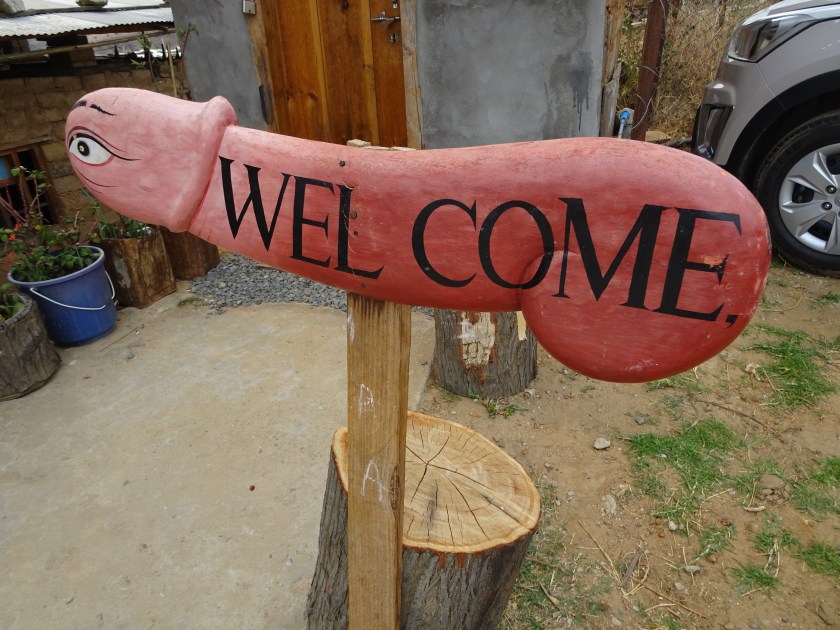
  • The phallus, or penis, is seen as a precious treasure that gives life and wards off evil. It is a cultural, spiritual and religious symbol.  Therefore, big wooden red phalluses are typically hung at the entrance of traditional houses.
  • Polygamy and polyandry (when a woman has more than one husband) are surprisingly legal in Bhutan, although they are not common these days.
  • There are twenty different districts throughout Bhutan and twenty four different dialects.
  • Bhutan is the world’s only carbon sink, meaning it absorbs more CO2 than it gives out. It sells hydro-electrical power, making it the only country whose largest export is renewable energy.
  • 72% of the country is forested. In fact, it is in the country’s constitution to keep 60% of its land forested. Respect for the environment, the eco system and all species is a serious matter in Bhutan. Anyone caught killing an endangered species, faces the harsh sentence of life in prison.
  • Thimpu, Bhutan’s capital, has been drastically growing over the last decade with a lot of new modern buildings.  However, all buildings are mandated to maintain the same aesthetic traditional look of the Buddhist architecture and can be no taller than six stories high.

Here are some random facts as well:

  • Dzongkha, the national language (a derivation of the Tibetan language, Choikd)
  • Kuzuzangpola, meaning hello and well wishes
  • Log Jay Gay, meaning goodbye and we will meet again
  • Men wear a gho, which is a long gown belted at the waist
  • Women wear an ankle-length dress called kira, which is mostly hand woven with rich traditional patterns
  • Drinking age is 18
  • The average life expectancy in Bhutan is 66 years for men and 70 years for women
  • Raven is the national bird
  • Takin is the national animal
  • Swallowtail is the national butterfly
  • Blue Poppy is the national flower
  • Cypress is the national tree
  • Archery is the national sport
  • Butter tea is the national tea/drink
  • Ngultrum is the national currency (introduced in 1974 it is pegged with the Indian rupee)
  • There is only one escalator in the entire country and it is in a Thimpu shopping mall.
  • There is only one double lane road in the entire country and it is in Thimpu.
  • In 2015, Bhutan set a Guinness World Record by planting almost 50,000 trees in just one hour. Tree planting is popular in the country because they are seen as a symbol of long life, beauty and compassion.
  • In 2016, the first and only helicopter in the entire country made its debut.
  • Agriculture is its major industry with rice, fruit and dairy industry (yaks).
  • Plastic bags have been banned in Bhutan since 1999.
  • Bhutan has the world’s highest unclimbed peak, Gangkhar Puensum, a mountain so sacred by the Bhutanese that the government has banned mountaineering on any peak above 19,685 feet.

“Here in this tiny kingdom where luxuries like television and Internet were only recently introduced, where villages and communities still live in a time warp of the old age and where smiling people walk down the streets leisurely”, you can’t help but have a warm fuzzy feeling inside. “A country where mysticism meets reality, where legend is history, magic is science and reincarnation a fact of life”.  Bhutan is not perfect, nothing is, but it sure has its core values in order and for that, I fell in love.

*Most of this information has been provided by Bhutan Swallowtail, the tour group we went with. 

Paragliding over Pokhara

Saturday, March 12, was a day I had been looking forward to for quite some time.  When I started doing research for this trip back in October, I kept reading over and over again that Pokhara was one of the best places in the world to go paragliding.  The main reason for this is because of the incredible mountain views with supporting factors being stable thermals, convenient take-off and landing zones and the safety of a large lake below you.  It didn’t take much convincing for me to be convinced I absolutely had to do this.  Luckily, Jennifer and Vinny were both on board as well.  You only live once, right?  When I turned twenty five, I went sky diving with my friend Lindsey down in San Diego as a way to celebrate making it a quarter of a century.  It sure was an exhilarating experience and I always knew I wanted to do it again. For now, paragliding will fill that craving.

In the morning, it was pretty overcast. We all had high hopes the clouds would soon burn off and the sun would start to brightly shine, welcoming us to its sky with open arms (or open rays I guess).  Every hour I was doing my “come out to play sunshine dance” because how could something l’d been so excited about for so long not go perfectly?

Around 11am, Phoenix Paragliding (owned by an Austrian husband and a Nepalese wife) came to pick us up at Hotel Middle Path.  We swung by their offices about ten minutes away, filled out some paperwork, signed our lives away and then drove up a steep hill, higher and higher and higher and higher above ground, until we finally reached Sarangkot Mountain, which is where we will be jumping off from.  Literally, jumping off.  Jumping off a cliff that is.  Are we crazy?  The owner, Jochen, wanted to wait a little while until the wind picked up a bit and with the optimistic thought that it would get a tad bit clearer with every passing minute.  Unfortunately, unlike that morning we went to the Taj Mahal, it never really cleared up. I was so bummed I wasn’t going to get the full experience of seeing the various Himalayan ranges.  I wanted to scream to the weather gods, “why are you doing this to me!!!!!!!!!” but then I took a step back (luckily not a step forward or else I wouldn’t be writing this right now), observed everything around me and realized who cares if the weather isn’t perfect.  You are about to go paragliding, in Nepal, with two very important people in your life by your side.  What else can one need?  I’m a lucky girl to be here and if I have to provide my own sunshine, so be it.

DCIM139GOPRO

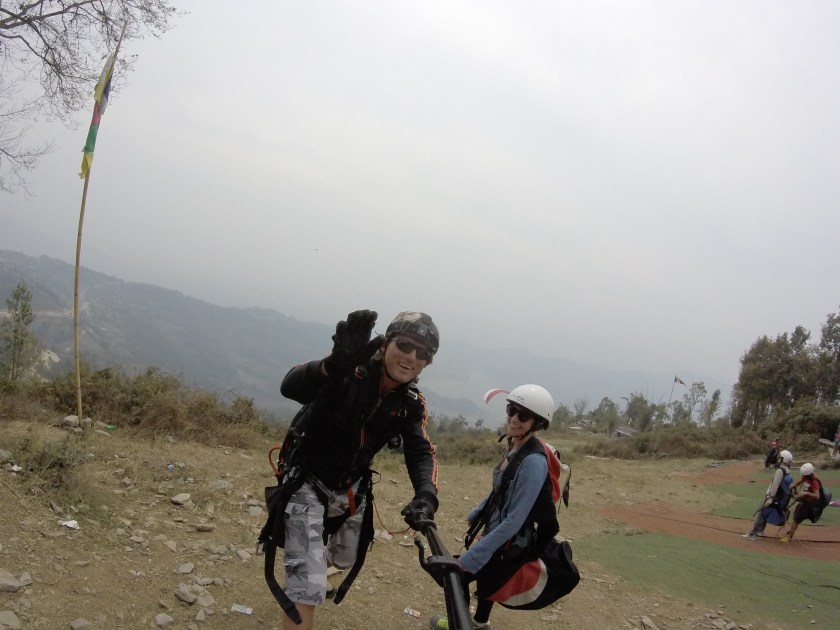
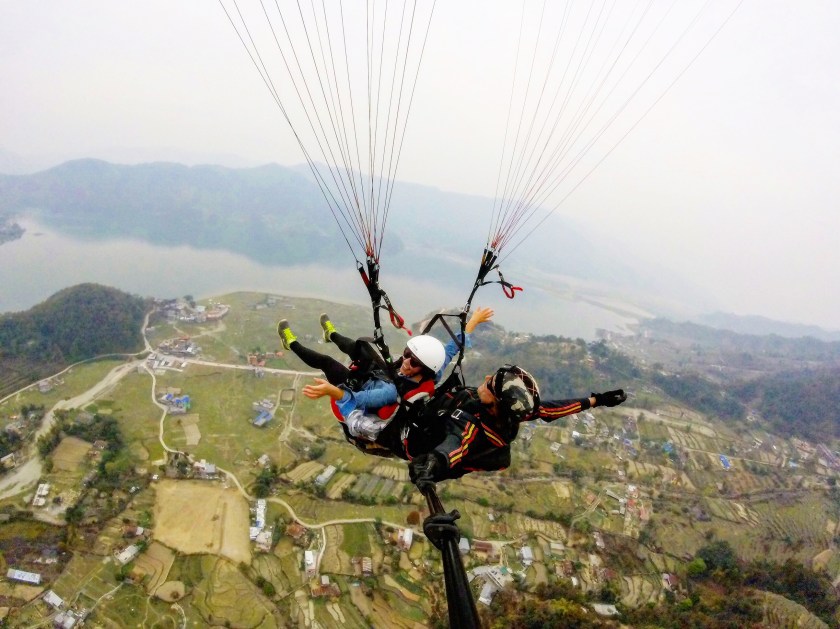
My pilot was the Austrian owner while Vinny’s pilot was French and Jennifer’s was Japanese (you can slightly seem them in the photo above to the right).  Very ethnically diverse staff they have.  It was a United Nations party thousands of feet above sea level.  Once we got the green light to begin the pre-flight preparations, it was go time.  No turning back now.  The three of us were carefully dressed in helmets and harnesses and were given very simple directions.  When they say hit it, you walk, run, run, run and once you no longer have the ground underneath (ahhhhhhhh), keep your legs in running position until they say relax.  At that moment, it was smooth sailing.  I just sat back, let my legs loosely dangle in mid-air like spaghetti noodles off of a fork, observed all the incredible sights from high in the sky, smiled for the GoPro camera and absolutely loved every minute I was gracefully soaring like a bird.  If there was a theme song for this experience it would be Tom Petty’s, Free Falling.  “And I’m freeeeeeeeeeeeeeee, freeeeeee falling”!

DCIM139GOPRO

DCIM139GOPRO

DCIM139GOPRO

DCIM139GOPRO

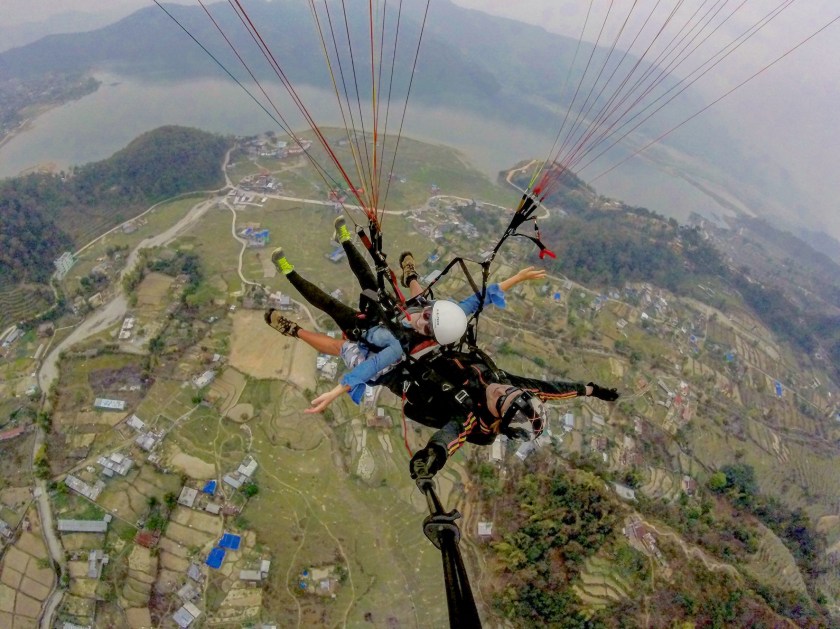
The whole flight was only twenty minutes due to the lack of wind to keep us up but it sure was fun while it lasted.  As we glided over the lake, we did some crazy spins (on purpose, don’t worry) and my stomach dropped it liked it was hot.  It’s that feeling you get when you go on a rollercoaster and it suddenly dips faster than you can handle.  Such an adrenaline rush.  But in a good way.  The landing was pretty easy as well.  There was a large open grass field that you basically run for a few steps on then your mission is successfully complete.  Just a typical Saturday, no big deal.

IMG_1797

IMG_1808

IMG_1804

After we celebrated with our two feet proudly on the ground and patted ourselves on the back for surviving, we headed to lunch at Cafe 17 French Bakery, which was in town and recommended by the folks at Phoenix Paragliding.  It was a very small, simple, sweet little place that only had a few menu options.  We sat outside, enjoyed some of their fresh homemade bread and then asked for the check.  Usually when this step in the process happens, the waiter brings a printed or written piece of paper that lists out what you ordered, how much it was, then adds in tax and sometimes service charge.  Well, not here.  The waiter came back with a calculator that read 675.  HA!  This was priceless.  Definitely a first.  I just love the simplicity and they are saving a tree so go them.

IMG_1809

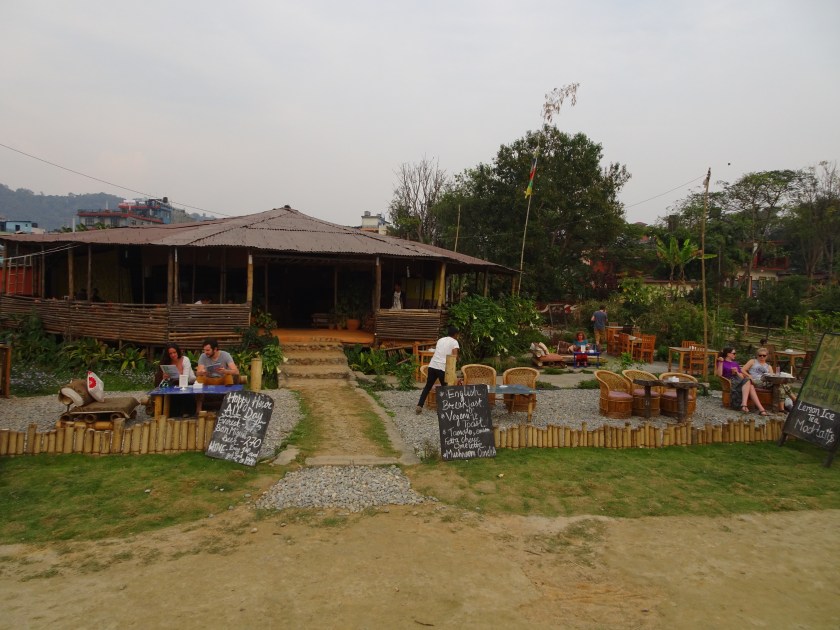
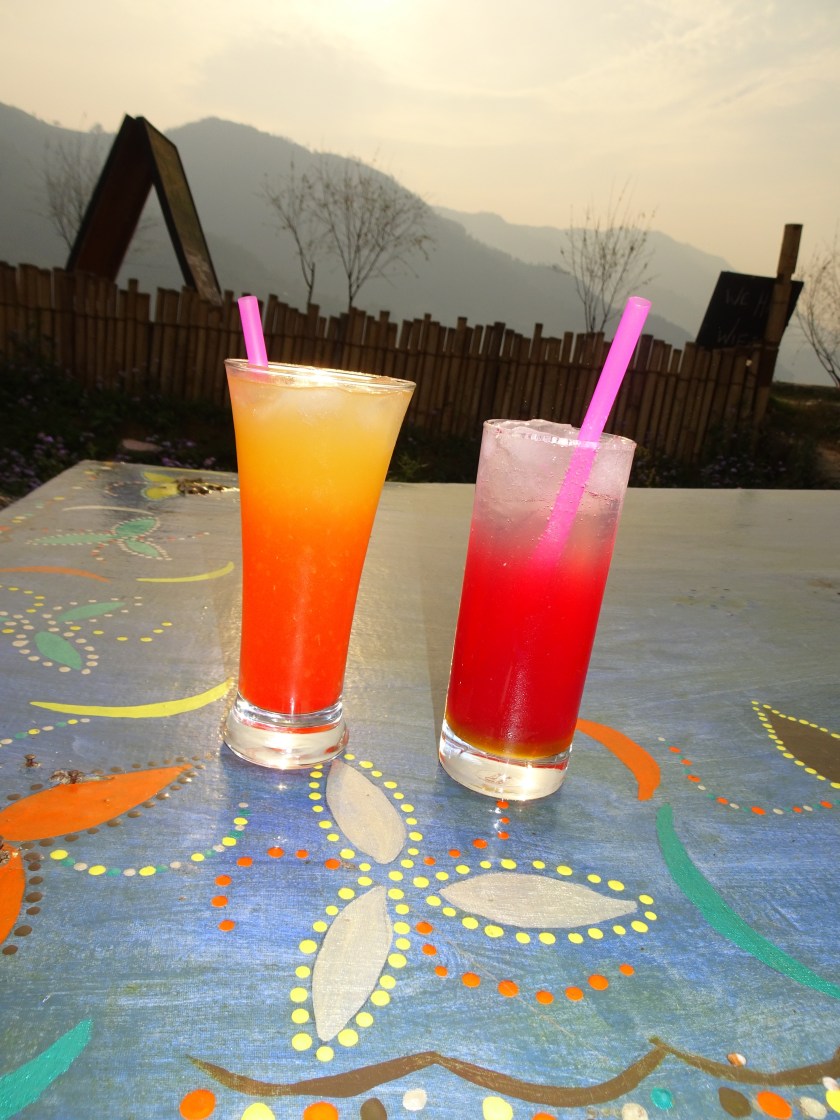
For the rest of the afternoon, Jennifer and I walked along the lake while Vinny chilled back at the hotel.  We ended up at a place called Bamboo Cafe, which was right on the water, and ordered fancy “mocktails” (cocktails without the alcohol, don’t judge) and a butterscotch cake with ice cream.  Such a random combination,  but who cares, we can have our cake and eat it too.  We sat outside reminiscing on countless childhood memories that would sporadically pop into our minds.  And there sure were some classic ones indeed.  When you have literally known someone your entire life it’s so incredible to remember the good old days when life was so much simpler than it is now.  Almost every birthday, every holiday (Easter, Fourth of July, Halloween, Christmas Eve, etc.) and any other excuse our parents could think of was spent together ever since we were born.

DSC05767

DSC05760

DSC05761

DSC05753

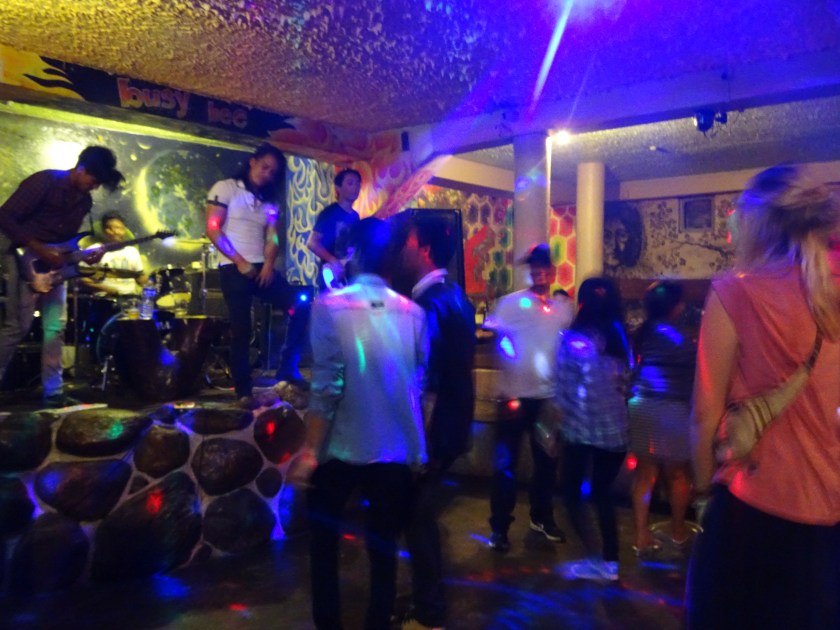
That night, we all had dinner at Busy Bee Cafe, which considers themselves “a place like nowhere else”.  When we first got there, it was pretty quiet, just a few other people.  But by 9pm, it was packed.  People were smoking hookah, drinking beer and there were random sports being televised on big screens such as cricket, badminton and European soccer.  But the best thing about this night was the live Nepalese cover band of about four guys.  They sang everything and anything including a reggae version of Adele’s “Someone Like You”, Maroon 5, Oasis, Pearl Jam, 4 Non Blondes, Kings of Leon, Red Hot Chili Peppers and so many others.  The three of us just sat there for a few hours and sang along, out loud, as if we were the only ones in the restaurant.  So much fun.  Definitely a night to remember.

DSC05783

DSC05782

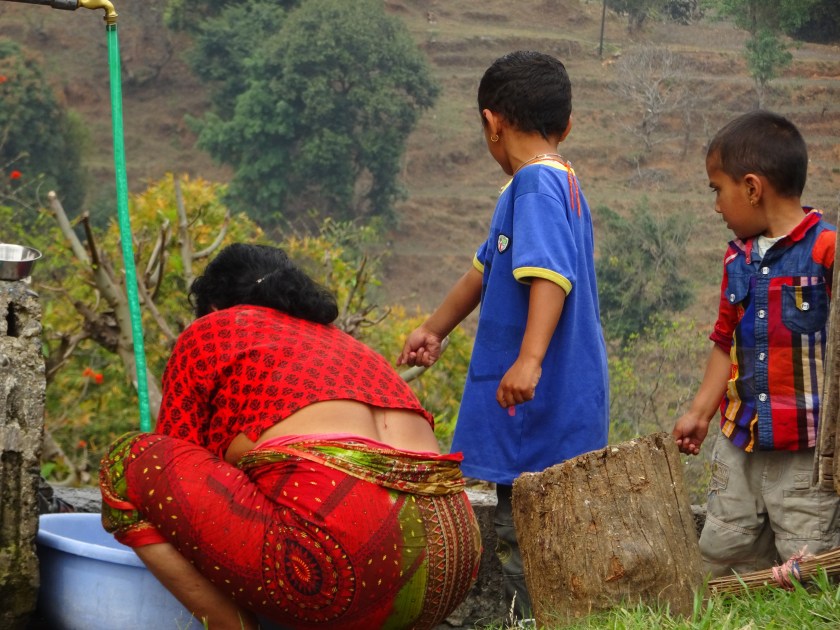
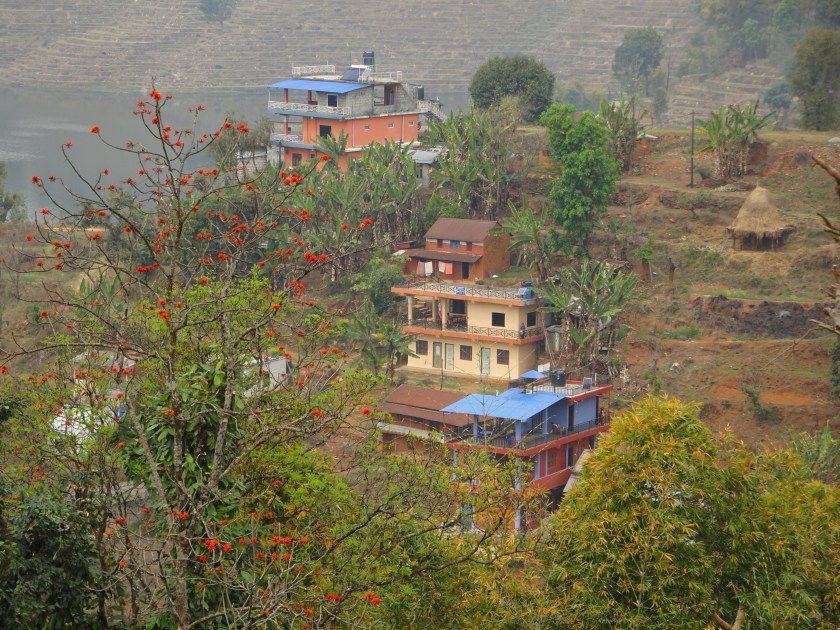
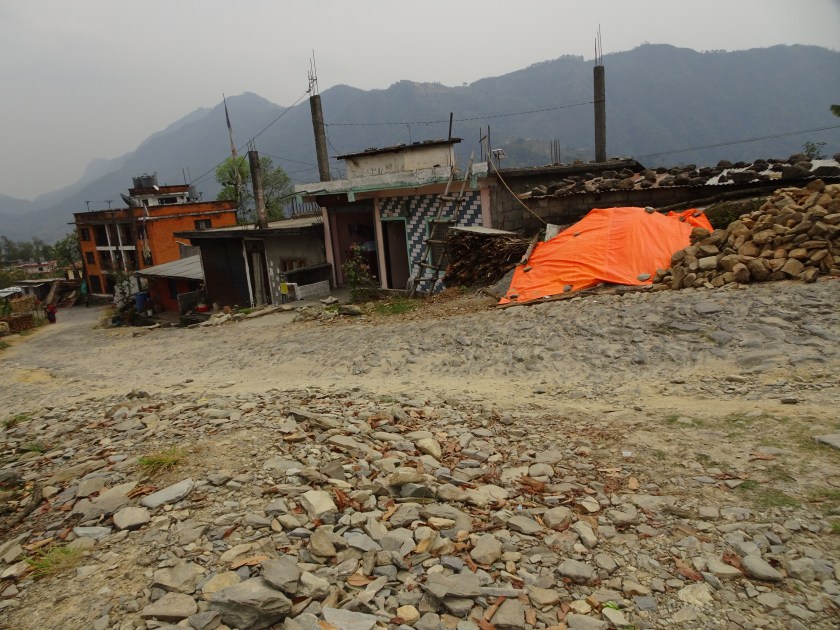
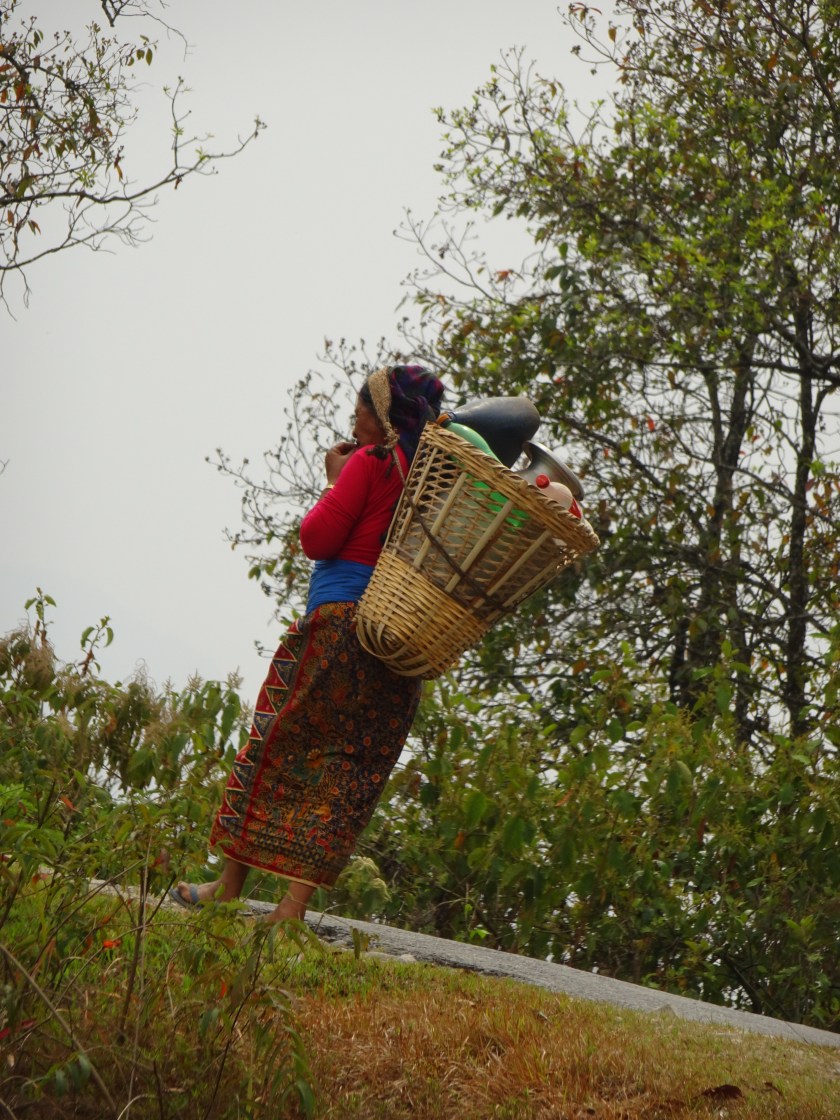
Today, March 13, was our last day in Pokhara.  We hired a driver to take us to two fairly random sights a bit further away.  Sundari hilltop, which was real life, no tourism influence.  Unkept roads,  tiny villages and locals going about their everyday routines.

DSC05802

DSC05797

DSC05795

DSC05791

DSC05787

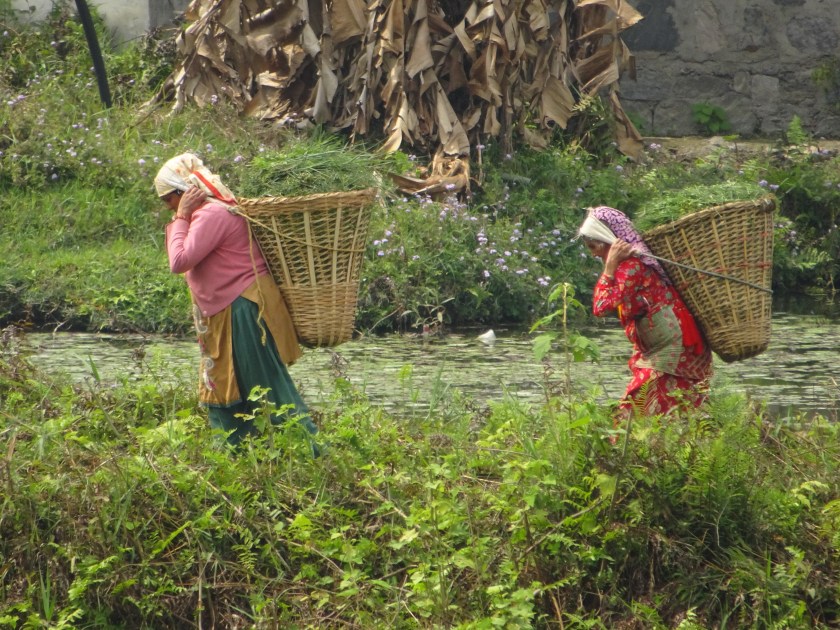
Begnas Lake, which was a very rural non-touristic area that resembled life back in the 1800’s.  Not that I was alive then but what I’ve at least read about in books and seen in photos.

DSC05806

DSC05804

DSC05813

DSC05819

DSC05821

DSC05825

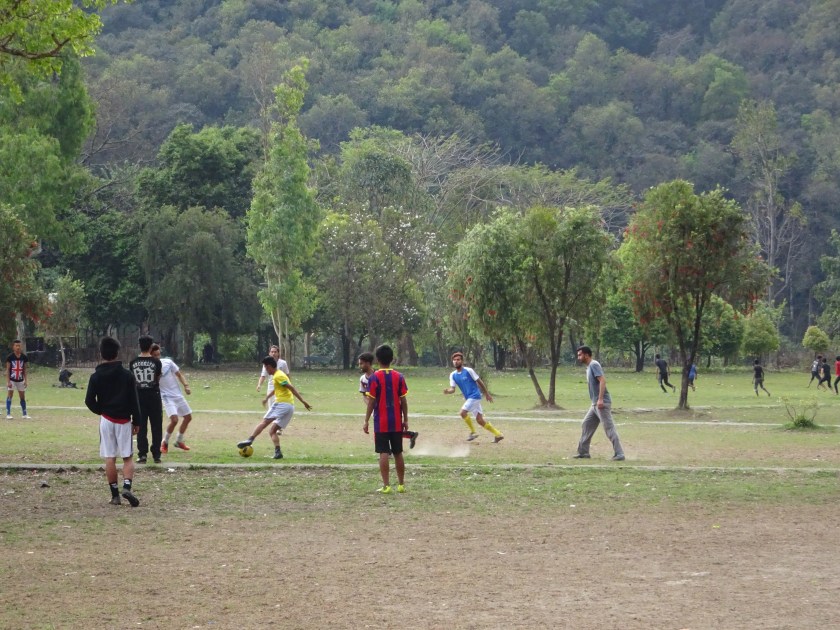
When we got back to town, we walked to Boomerang for lunch, wandered around the other side of Pokhara (which seemed a little more upscale and less backpacker-ish), found a nice park where locals were playing soccer and as we were heading back to our hotel, it started to downpour. Raining cats and dogs.  We took cover in a nice mans jewelry shop hoping it would stop in a few minutes.  The guy didn’t even ask us to buy anything in return, he just wanted to help.  I just love everyone in this country.  Some people hid under trees and in random shops while others weren’t phased by getting drenched so they continued on with their day.  After about thirty minutes it calmed down a bit so we hopped in a cab and made our way home.

DSC05831

DSC05832

DSC05834

DSC05844

DSC05845

Our last supper was back at Cafe Concerto because we all loved it so much.  And Vinny wore his new Nepali hat, which at least three local GUYS told him he looked very handsome.  I have to agree.

DSC05848

Pokhara was such a chill, calming, almost detoxing place.  You can’t help but feel relaxed here.  Maybe too relaxed at times.  Four nights was a little long but it provided us all with a chance to go slow.  It was fairly touristy in certain areas but there was plenty of things to do and see that allowed us to escape those massive crowds from time to time.  If I could do it all over again, I would most likely do one less night in Pokhara and add one night to Lumbini, the birthplace of Buddha himself.  But if we always knew then what we know now, life wouldn’t be half as exciting.  You live and you learn and if you don’t learn, you aren’t really living.

Tomorrow we will be heading back to Kathmandu, which is about six hours by car, on the same narrow canyon like road we took to Chitwan and Pokhara.  Oh geez, here goes nothing.  From there, Jennifer will head back to LA that night and we will head to Bhutan the next morning.  The one thing I am going to miss the most is picking up Jennifer on our walks through Patan or yelling from across the balcony in Chitwan or calling her in her room in Pokhara.  We sure had an incredible eleven days of sightseeing, adventure, eating, laughing and enjoying the simple things in life.   Miss your face already, Jaye!

Overall, I loved Nepal.  Just like India, it can be dirty, crowded, polluted and sadly very poverty stricken but it definitely has its adoring charm, its scenic beauty, its calm demeanor and its incredible history.  I think we had a perfect balance of city life, rural life and nature life.  It will continue to boggle my mind that electricity is so hard to find on a consistent basis.  It goes on and off, day or night and you never know when it will happen or how long it will be for.  It’s just crazy how something you never had to think twice about at home has become such a rare commodity, almost a luxury, here in Nepal.

In the end, it was the people that really won my heart over.  They are genuinely and unconditionally nice, welcoming, accommodating, happy and overall, good spirited.  Whether it was the managers at our hotels/AirBnB’s, our cab drivers, waiters at restaurants or random locals we met on the streets, everyone was just amazing.  And to think they are still like this despite their hardships is beyond inspiring.  Less is more and they are the perfect examples of that.

Until next time, Namaste Nepal…